shit i didn't know Fall down a rabbit hole with TP.
Rabbit hole No. 002

A hundred trillion ghosts just went through you

Mostly from the sun. About 100 trillion a second. Maybe one of them hits you in a whole life.

About 100 trillion neutrinos pass through your body every second. IceCube says so, and UNLV physicist Michael Pravica gave Live Science the same number. Nearly all come from the sun, says UW-Madison’s Lu Lu.162

You will not feel them. The flood is real. The collision is the part that almost is not.

Or just watch it · 1:04

Rather watch? Here's the whole thing in about a minute.

Same rabbit hole, told by TP, in your pocket.

The core idea

A particle that does not shove.

A neutrino is a speck with no electric charge, and a mass so small that for years the catalogs set it to zero. Light bounces off you because electric charges shove. A neutrino does not shove. It can fly through the Earth and keep going. People call it a ghost particle because it just about never hits anything.2

About 100 trillion of them a second. He took a swing:

He missed. They did not notice. That is the whole personality.

The sun makes them in its core, where hydrogen fuses into helium. Fuse means the sun sticks hydrogen atoms together until they become helium, and the neutrinos are what leaks out of that job. They leave at almost the speed of light. About eight minutes later they are here. At night they come up through the floor, because the sun is on the other side of the planet:

You are not a wall to them. You are a rumor.

The reason anyone invented them is a bookkeeping error that would not go away. In a kind of radioactivity called beta decay, a nucleus, the core of an atom, spits out an electron. If that were the whole story, every electron from the same kind of nucleus would leave with the same energy, the way a ball dropped from one shelf hits the floor at one speed. The electrons came out with a smear of energies. Either energy was not conserved, which would crack physics, or something invisible was carrying the rest.

In December 1930 Wolfgang Pauli wrote to a meeting in Tübingen, to the “radioactive ladies and gentlemen,” and offered what he called a desperate remedy.3

HELP

A light, neutral particle that took the missing energy. He was embarrassed. He was not sure anyone could catch it. Fermi and Edoardo Amaldi later named it the neutrino, a little neutron. Pauli had been using the word neutron, and then James Chadwick found the actual neutron, so the little one needed its own name.3

Catching one took until 1956. Clyde Cowan and Frederick Reines parked a detector next to a nuclear reactor in South Carolina, a firehose of antineutrinos, the antimatter twin. An antineutrino is the same ghost with the charges flipped. It hits a proton, the core of a hydrogen atom. A positron, an antimatter electron, and a neutron come out. They saw that. Reines got the Nobel Prize in 1995. Cowan had died, and the prize is not given after death.34

The 100 trillion is not a headcount of your torso this second. Detectors record the tiny fraction that hit, then work backward. Lu’s picture is a coarse net in a river. If you know the net, how long it was in the water, and how easily the fish slip through, you can estimate the river.2

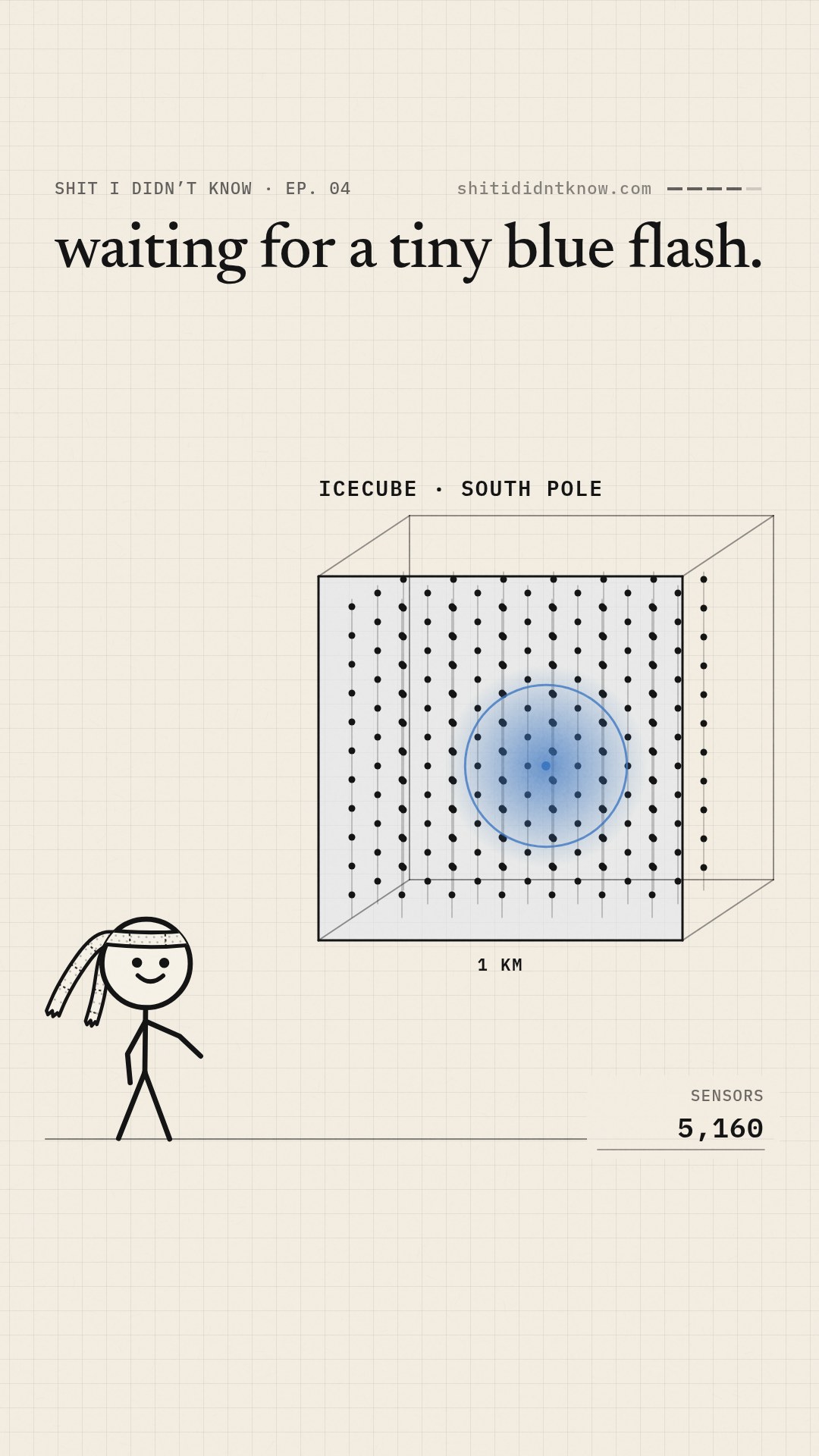
IceCube’s net is a cubic kilometer of Antarctic ice. A human body is a terrible net. That is why the traffic and the “maybe one hit in a life” can both be true.

Lu’s line on how many actually hit you: over a whole lifetime you should expect no more than roughly one interaction in your body, perhaps a few.2

IceCube puts the same idea on a detector the size of a person: about 100 years for one interaction, and about 100,000 years in the high-energy range IceCube was built for.1 A lifetime and a century are the same neighborhood. A hundred thousand years is a different faucet. The flood is real. The collision is almost not.

Go nerdieropen if you want the footnotes of the mechanism

There are three flavors: electron, muon, and tau. Flavor is just physicist for type. A muon is a heavier cousin of the electron. A neutrino is born as one flavor and can arrive as another. That swap is called oscillation, and it only happens if the neutrinos have mass. The Standard Model, the rulebook of particles, had required them to be massless. Oscillation says the rulebook is not the whole story. It still does not weigh the three masses in grams. Which one is heaviest got a first hint in 2026, and it’s a lean. Nobody’s calling it yet.511

The 1998 result from Super-Kamiokande, a water tank deep in a mine at Kamioka in Japan, was about atmospheric neutrinos, the ones cosmic rays make in the air. Cosmic rays are particles from space hitting the atmosphere. Those neutrinos changed flavor on long paths through the Earth. The solar puzzle, decades of experiments undercounting electron neutrinos from the sun, was closed by the Sudbury Neutrino Observatory. The sun was making the right number. A share of them had changed clothes on the way. Takaaki Kajita and Arthur McDonald shared the 2015 Nobel Prize for those two proofs of oscillation.5

How much lead stops one? CERN says a typical neutrino could cross a light-year of solid lead before it interacts. A light-year is the distance light travels in a year. The Nobel Foundation’s theme article says solar neutrinos can pass through several light-years of lead before they are absorbed.34 Higher energy, shorter trip. IceCube has watched the Earth stop neutrinos more than a million times more energetic than the sun’s. The solar flood still goes through the planet. You do not.6
Since you opened this page About 100 trillion a second

0

and counting

This is not a sensor. It is the published average, about 100 trillion neutrinos a second through a person, times how long this page has been open. Nothing is measured, stored, or sent.

Try it on yourself About 100 trillion a second

Nothing you type is stored or sent anywhere. The age stays in this page, in your browser, and the math runs here.

Type an age. This is the published average times the seconds in that many years, not a count of you.

How much lead to stop one? A picture, not a ruler

1.0

Wait, what?

The weird bits.

Wait, what?

The sun is the faucet.

Lu told Live Science that nearly all of the neutrinos going through you come from fusion in the sun. A few come from farther away, including other galaxies. The counter on this page does not sort them. It uses the round total.2

Wait, what?

One hit in your whole life.

Lu: no more than roughly one interaction in your body in a lifetime, perhaps a few, and no health risk worth mentioning.2 IceCube: about 100 years for a person-sized detector, and 100,000 years at IceCube’s energies.1 A lifetime and a century are the same neighborhood. A hundred thousand years is a different faucet.

Wait, what?

IceCube sees 100,000 a year and still says you are empty.

About 100,000 atmospheric neutrinos a year in a cubic kilometer of ice. That’s about 275 a day. The ice is buried from 1,450 to 2,450 meters so cosmic-ray junk does not drown the sensors. The size and the depth are different reasons.1

Wait, what?

A star died, and the ghosts arrived first.

Supernova 1987A. Underground detectors recorded neutrinos hours before the light. Kamiokande II saw 11, a detector in Ohio saw 8, one in Russia saw 5. About two dozen, total, from a star in a neighbor galaxy. Fermilab and the Sanford lab both tell that story.78

Wait, what?

They still do not know the masses.

Oscillation proves the masses are not zero. It does not weigh them. KATRIN did put a ceiling on it: under 0.45 eV (electronvolts, the tiny unit physicists weigh particles in), less than a millionth of an electron’s mass.12 In September 2026 JUNO posted its first hint: the third mass is probably the heaviest. That’s about 2 sigma. Physicists count that one-sided, and 2 sigma is about a 1-in-44 chance the bump is just a fluke. They want 5 sigma, about 1 in 3.5 million, before they call it. So it’s leaning that way. Nobody’s calling it yet.11141516

Wait, what?

A fourth one might not exist.

A sterile neutrino would be a flavor that doesn’t even feel the weak force (the one that lets normal neutrinos hit anything at all), only gravity. JUNO lists hunting for them as something it might be able to do someday. Nobody has a confirmed one to put on this page.9

How a ghost gets caught

A mine, a cubic kilometer of ice, and one dead star.

Super-Kamiokande sits in the Kamioka mine and watches for a flash of light when a neutrino finally hits. That 1998 atmospheric result is half of the 2015 Nobel. SNO, in a Canadian mine, is the other half: the sun was fine, the neutrinos had changed flavor.5

IceCube is the brute-force version. One cubic kilometer. 86 cables, 5,160 light sensors in the ice, frozen in from 2004 to 2010. When a neutrino hits a nucleus, the debris moves faster than light can move in ice, which is allowed, and that makes a faint blue glow the sensors can see. From the glow they get an energy and a direction.12

The 1987 supernova is the proof that this is not a parlor trick. The neutrinos left the collapsing core and got out. The light had to ride the shock, the blast wave ripping out through the star. So the ghosts arrived hours earlier:

The people running the detectors only noticed after astronomers saw the star.7 If a star in our own galaxy dies while a big detector is on, the warning comes first, and the telescopes get a head start.

Is this BS?

The round number is fine. The mysteries are still mysteries.

“A hundred trillion” is an estimate with a friendly face. It comes from the few that hit a detector, scaled up by the size of the net.2 If someone tells you it is an exact census of your ribs this second, they are selling the rounding. “Maybe one hit in a life” is Lu’s ceiling, with room for a few. IceCube’s 100 years is the cousin of that sentence. Neither is a promise that your particular body gets exactly one.

The masses are still unknown as numbers. In September 2026 JUNO posted its first hint: the third mass is probably the heaviest. That’s the same about-2-sigma hint. They still want 5 before calling it.11 A sterile neutrino is a maybe. And the highest-energy ones IceCube catches, from places like the neighborhoods of giant black holes, are rare enough that each one is a press release. The solar flood is the ordinary one. The weird ones are not.19

Where this page lands. The flood is real. About 100 trillion a second, mostly from the sun, and your body almost never notices. The hundred trillion is a round estimate scaled up from the few that hit a detector. It is the right picture. The exact masses are still unweighed, and the September hint on which one is heaviest is a lean.

Why it matters now

One experiment is already taking data. One is still being built.

JUNO, the Jiangmen Underground Neutrino Observatory in China, finished filling a 20,000-ton detector of liquid scintillator, a liquid that flashes when a particle hits, and started physics data on August 26, 2025. The Chinese Academy of Sciences said so. Nature published the first oscillation measurement on June 10, 2026, from 59 days of data.913 It watches antineutrinos from reactors about 53 kilometers away. The question it is built to answer is the mass ordering: is the third neutrino heavier than the second. In September 2026 the collaboration posted a longer analysis, 207 days, that leans that way at about 2 sigma, that same fluke bar, once other experiments’ mass-splitting measurements are folded in. Physicists want 5 before calling it.11 It also lists sterile neutrinos as something to look for, which is not the same as having found one.

DUNE, the Deep Underground Neutrino Experiment, is not taking that data yet. First data from the South Dakota detector around early 2030, Fermilab’s beam in 2031. A June 2026 collaboration talk is where that schedule is written down.10 The point of the machine, when it is on, is the same list: ordering, the three-flavor picture, and a supernova in our galaxy, which would light the detector up with thousands of events instead of 1987’s two dozen.8

That is the stake in 2026. The particle Pauli apologized for is now a tool. It told us the sun was fine. It arrived before the light of a dying star. The next detectors are there to weigh the thing, or at least to say which way the weights run. Until they do, the honest sentence is the short one. They are going through you. Almost none of them notice.

Go deeper

The pages the numbers came from.

Sources ()
  1. IceCube Neutrino Observatory, quick facts. About 100 trillion a second. About 100 years for one interaction in a person-sized detector, and about 100,000 years at IceCube energies. About 100,000 atmospheric neutrinos a year. Detector depth and sensor count. IceCube.
  2. Charles Q. Choi, “How many cosmic particles are passing through your body at any moment?”, Live Science, August 30, 2026. Michael Pravica, University of Nevada, Las Vegas, gives the 100 trillion. Lu Lu, University of Wisconsin-Madison, says nearly all come from the sun, and no more than roughly one interaction in a body per lifetime, perhaps a few. Live Science.
  3. CERN, “The puzzle of neutrinos, seventy years on.” Pauli’s December 1930 letter, the desperate remedy, Fermi and Amaldi, the 1956 detection, a light-year of lead, three flavors. CERN.
  4. Nobel Foundation, “High energy neutrinos from the cosmos.” Cowan and Reines, 1956. Solar neutrinos and several light-years of lead. Nobel theme.
  5. Nobel Prize in Physics 2015, press release. Kajita and McDonald, for neutrino oscillation and mass. Nobel 2015.
  6. IceCube, November 2017. “About 100 trillion neutrinos pass through your body every second.” The same release is the Earth-shadow result: the planet stops neutrinos more than a million times more energetic than the sun’s. The solar flood is a different energy. IceCube.
  7. Fermilab, “Waiting for neutrinos,” March 2019. SN 1987A neutrinos hours before the light. IMB 8, Baksan 5, Kamiokande II 11. Fermilab.
  8. Sanford Underground Research Facility, on DUNE and supernovas. About 25 neutrinos from SN 1987A. A galactic supernova would be thousands in DUNE. Sanford Lab.
  9. Chinese Academy of Sciences, August 26, 2025. JUNO filled and started data taking. 20,000 tons. Mass ordering. Sterile neutrinos listed as a search. CAS.
  10. DUNE status, June 2026 collaboration talk. Installation underway. First data from the South Dakota detector around early 2030. Fermilab’s beam in 2031. June 2026 talk.
  11. JUNO Collaboration, “Measurement of Neutrino Oscillation Parameters at JUNO and Indication of the Neutrino Mass Ordering,” arXiv:2609.37895, September 2026. 207.2 live days. With long-baseline constraints on the mass splitting, normal ordering is favored at a one-sided significance of at least 2.1 sigma. arXiv.
  12. KATRIN Collaboration, “Direct neutrino-mass measurement based on 259 days of KATRIN data,” Science, April 10, 2025. Upper limit on the effective electron antineutrino mass, under 0.45 eV at 90 percent confidence. An electron’s mass is about 511,000 eV, so 0.45 eV is under a millionth of that. Science.
  13. JUNO Collaboration, first oscillation results, Nature, June 10, 2026. 59.1 days of data after the detector was filled in August 2025. Nature.
  14. Particle Data Group, “Statistics,” Review of Particle Physics (2023). A 5-sigma effect is a one-sided p-value of 2.87 × 10⁻⁷, about 1 in 3.5 million. Table 40.1 lists the two-sided tail outside ±2 sigma as 4.55 × 10⁻², and says a one-sided limit is half of that, about 1 in 44. JUNO’s posted hint is at least 2.1 sigma, so its fluke chance is a little smaller than the exact-2 line. PDG.
  15. NIST/SEMATECH e-Handbook, section 1.3.6.7.1, area under the standard normal curve from 0 to z. At z = 2.00 the table reads 0.47725, so one tail is 0.50000 minus 0.47725, which is 0.02275, about 1 in 44. NIST table.
  16. Evelyn Lamb, “5 Sigma What’s That?”, Scientific American, July 17, 2012. Five sigma, counted one-sided the way particle physicists do for a discovery, is a p-value of about 3 × 10⁻⁷, or about 1 in 3.5 million. The piece also says the two-sided reading of the same bump is about 1 in 1.7 million. The everyday “1 in 20” is that two-sided 5 percent line. This page uses the one-sided count. Scientific American.
Newsletter

Get the next rabbit hole before everyone else.

Just a quick email when a new rabbit hole drops. If you were on the old Substack, you're already on it.

Or subscribe on Substack