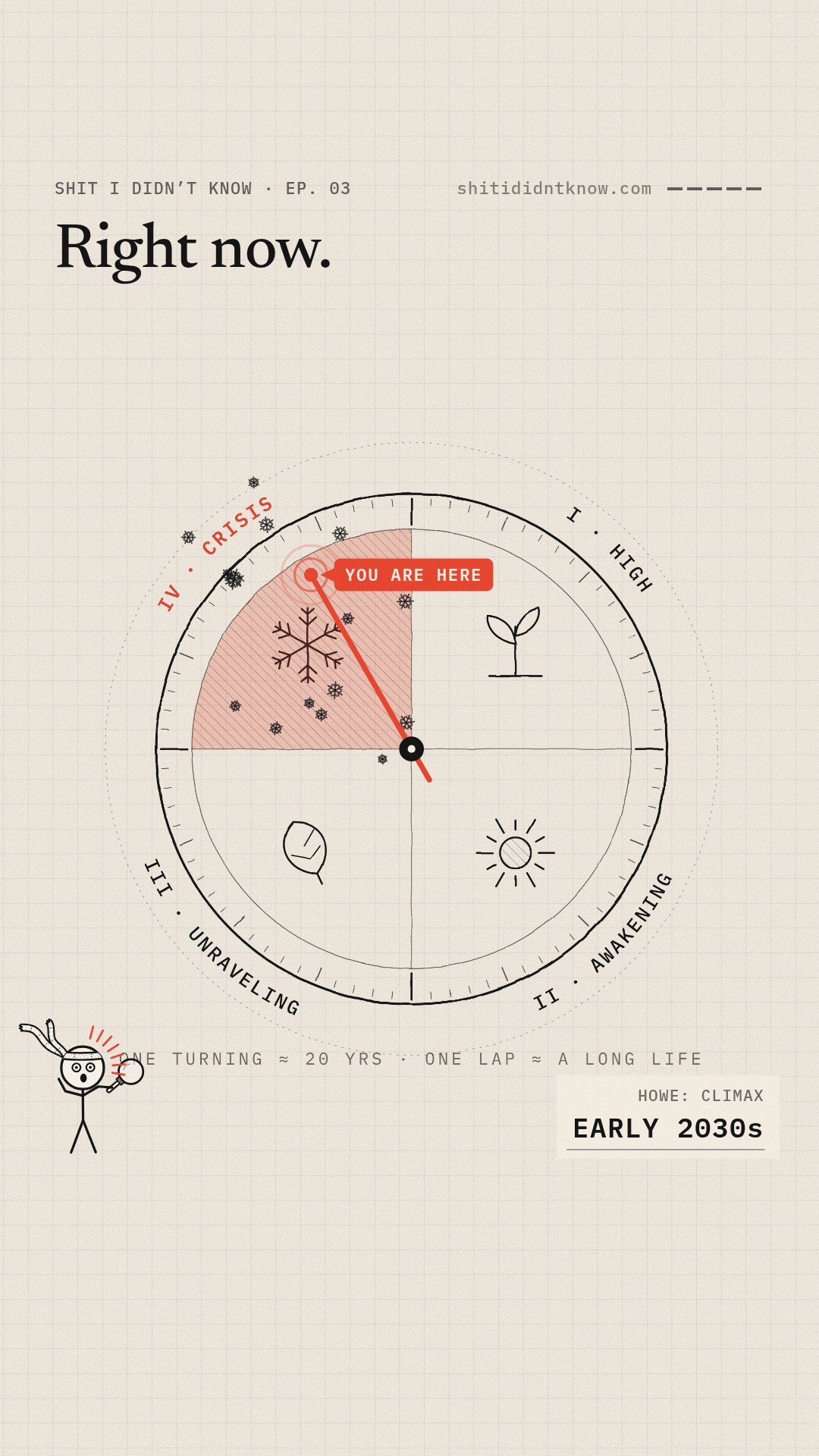
Does history run on an 80-year clock?
So these two guys figured history kinda runs in seasons. About every 80 years, everything falls apart and gets rebuilt. Drag through 600 years and watch it happen.
From 1929 to 1946 the country got a market crash and then a world war. In 1997 William Strauss and Neil Howe called that stretch a winter, and wrote that the next one would start around 2005. Howe now says it started in 2008 and runs into the early 2030s.12
You already know the part underneath it. A war at eight and a war at twenty do not make the same person. A country full of those people feels different twenty years later. That part is ordinary.
The wild claim is the schedule. They say the whole pattern comes back about every eighty years, in four moods, and that the hard mood is the one we are in.
Your age is the gear. Their calendar is a story about that gear.
The whole thing in 30 seconds. Four moods, about twenty years each. The mood you are born into is supposed to be your job in the story. Their last winter was 1929 to 1946. The 1997 book guessed the next winter would wind down around 2026. Howe now says we are still in it.
Or just watch it · 1:02
Rather watch? Here's the whole thing in about a minute.
Same rabbit hole, told by TP, in your pocket.
Four moods. Then it repeats.
History, in this story, is not a ramp that only goes up. It is a year. Right after a big fight, everybody puts on the same vest and gets to work on the hall:
They call that a High. New building, matching uniforms, a ribbon that could not wait.
About twenty years later the same steps are full of kids:
An Awakening. The hall has to explain itself. He did not come empty-handed.
Then the crew goes home. Each person is alone, phone up, and the roof is already on its way down:
An Unraveling. The hall comes apart in public. He has somewhere else to look.
Winter is the hall on fire, with the next hall going up beside it:
Crisis is their word for winter. He swung the hammer at the start and at the end.12
Each mood runs about twenty years. Four of them add up to about one long human life. They call that full lap a saeculum. The old Latin word meant a long life, and also a natural century. Their laps are not a boxed hundred years on a wall calendar.1
Drag the years 1997 dates. The 2008 bar is Howe, later.
1933 Turning IV · Crisis
The Great Depression, and yeah, a world war's coming. Year 4 of this one.
- This one started
- 1929
- Last one
- 1860
- Time between
- 69 years
← drag, or use ← → keys
The red stuff is what's changing.
The gear is how old you are.
A turning is one of those moods. The engine is age. One kid, one war, from age eight to seventy. That is one full lap, lived by one person.
At eight the war is only a noise through the door. He aims for the table:
The table was built for dishes. The door keeps banging.
At twenty the same kitchen has a piece of paper in it:
The paper has his name. The door is no longer just a noise.
At forty-five he is the one at the table. The door used to be in the other room. Now he is the one sending people through it:
Same war. He holds the list.
At seventy the war is a story, and the listener missed it:
Strauss and Howe sort the chairs into four archetypes. An archetype here is a role, the seat you were born into. It is not a personality test.1
Born in a High, you are a Prophet. Indulged as a kid, preachy as a young adult, moralistic when you are old. Born in an Awakening, you are a Nomad. The adults are off finding themselves, so you grow up sharp and under-parented. Born in an Unraveling, you are a Hero. Watched over as a kid, then handed the heavy lifting in your twenties. Born in a Crisis, you are an Artist. Sheltered while the adults survive, then you come of age in the calm that follows.
The kids shaped by one season grow up and staff the next one. That is the whole machine.
Who got which chair.
The recent brackets they printed in 1997 are these.1 A cohort, the people born in one stretch of years, usually starts a couple of years before the season it is named for. Boomers begin in 1943, while the chart still says Crisis. That is not a typo.
One lap earlier, same book. Missionaries 1860–1882, Lost 1883–1900, G.I.s 1901–1924.1 Howe’s 2014 Forbes essay calls the kids after the Millennials Homeland, “born since 2005.” LifeCourse, their research shop, had been using that name since the mid-2000s.5 The chart keeps the Unraveling going until 2008. The tool shows both.
Your life in the seasons Strauss & Howe brackets, on this chart
Nothing you type is stored or sent anywhere. The year stays in this page, in your browser, and the math runs here. Leave the page and it's gone.
Type a four-digit year. Or hit try 1988, which is only a sample.
High, awakening, unraveling, crisis. The mark is this year. The dashed end is past the chart.
The dates live in the nerd drawer.
The moods are simple. The year-by-year list is not. It is in the drawer under this paragraph, with their own quotes. You can skip it and still follow the page.
For a kid
Six winters, named after the fact. A battle is not the whole mood. Their Revolution window stays open years after the shooting stops, because they are timing a feeling.
How it actually works
The Civil War is the broken gear. Five years, and they say that saeculum has no Hero. The Progressives, their name for people born 1843–1859, not the political movement, are filed as Artists.1 If the pattern were a law, that lap would have minted a Hero group. They say it did not.
Go nerdier open if you want the footnotes of the mechanism
The book marks these Crisis windows. The English civil wars called the Wars of the Roses, 1459–1487, climax 1485. The Armada, Spain’s fleet against England, 1569–1594, climax 1588. 1588 is the year the fleet sailed. The mood started earlier. The Glorious Revolution, the 1688 overthrow of the English king, 1675–1704, climax 1689. The American Revolution, 1773–1794, climax 1781. The Civil War, 1860–1865, climax 1863. The Depression and World War II, 1929–1946, climax 1944.1 A climax is the peak year they circle. It is not the last day of the mood.
The gaps between those start years are 110, 106, 98, 87, and 69. Climax to climax, counting from the years they circle, the gaps are 103, 101, 92, then 82 and 81. Same history, two yardsticks. Neither is a metronome.1
The 1997 forecast, in their words. “Around the year 2005, a sudden spark will catalyze a Crisis mood.” A catalyst is the spark. And later. “If the Crisis catalyst comes on schedule, around the year 2005, then the climax will be due around 2020, the resolution around 2026.”1 A resolution is the year they say the mood ends. Howe, in a 2023 interview, moves the hinges. High 1946–1964, Awakening 1964–1984, Unraveling 1984–2008, Crisis from the 2008 financial crash through the very early 2030s.2 The publisher’s note on the 2023 book says the climax comes by the early 2030s.3 Our dial stops at 2030 just to draw the shape.
Five things that stick.
The 2026 line was an if.
It is in the 1997 book, next to a spark around 2005 and a peak around 2020.1 Howe has since slid the ending into the early 2030s.2
Same season, wildly different length.
The Glorious Revolution, the 1688 overthrow of the English king, runs 1675–1704. Twenty-nine years. The Civil War, 1860–1865, is five. Start to start, the next winter begins only 69 years after this one. The early gaps run past a hundred.1 Winter here is a mood they named afterward.
They think the spark looks obvious only later.
The book says that as late as December 1773, November 1859, and October 1929, people did not know. The sparks it names are the Boston Tea Party, John Brown’s raid on the arsenal at Harpers Ferry and his hanging, and Black Tuesday.1 The raid was in October 1859. He was hanged on December 2. November sits between them, which is why that month is the one they pick.
One lap skipped the Hero.
“The Civil War Saeculum had no Hero archetype.” That is their line.1 The Progressives, that birth cohort from 1843 to 1859, are the Artists of a war too short to mint a Hero group.
Steve Bannon made a film about it.
In 2009, historian David Kaiser sat for an interview for Steve Bannon’s documentary Generation Zero, released in 2010. Kaiser wrote in Time that the film is about Strauss and Howe’s idea of a crisis every 80 years or so, and that Bannon was familiar with the theory.4
Three crises you can check.
These are the three American Crisis windows in the 1997 book that still have a paper trail. The mood labels are theirs. The dates of the fights are not.
The Revolution, their window 1773–1794
They start the Crisis at the Tea Party era and put the peak in 1781.1 The Boston Tea Party is December 16, 1773. Fighting starts at Lexington and Concord on April 19, 1775. Yorktown falls on October 19, 1781. The Treaty of Paris is signed September 3, 1783. Their window stays on through 1794, past the shooting, through the Constitution and the ugly first years of the republic.
The Civil War, their window 1860–1865
Lincoln is elected November 6, 1860. Fort Sumter is fired on April 12, 1861. Gettysburg is July 1–3, 1863, which they mark as the peak year.1 Lee surrenders at Appomattox on April 9, 1865. The American Battlefield Trust counts about 620,000 dead, roughly 2 percent of the population. That is about one person in fifty.6
The red one stays on the field.
The Trust will not take the higher counts, the ones around 850,000.6 Five years. Their shortest winter.
Depression and the war, their window 1929–1946
Black Tuesday is October 29, 1929. They put the peak in 1944, the year of the D-Day invasion.1 Picture four workers in 1933. One of them has no job. The Bureau of Labor Statistics puts that year at 24.9 percent.7 That figure is not the modern monthly survey. The BLS says the Current Population Survey, the monthly jobs survey, starts in 1940, and the 1930s rates are earlier estimates.
One in four. The fighting had not started.
Pearl Harbor is December 7, 1941. Germany surrenders May 8, 1945. Japan signs the surrender September 2, 1945. Their season ends in 1946, when the soldiers came home. The signing was a year earlier. Then the High.
The winter Howe says we are in.
- 2008
September 15, Lehman Brothers files for bankruptcy. Howe later points at the 2008 crash as the spark, the way 1929 was the last one.2 On the chart, this is year 0.
- 2009
Unemployment, with the usual summer and holiday swings taken out, hits 10.0 percent in October. Picture ten workers. One is out. The BLS says that was the peak after the recession, and that June 2009 was the recession’s official end.8 One worker in ten. Officially, the recession was already over.
- 2020
The World Health Organization says Covid-19 can be characterized as a pandemic on March 11.13 Their 1997 timetable had put a peak around this year.1
- 2022
Russia launches the full-scale invasion of Ukraine on February 24.14 A major war inside the season they had already circled.
- 2023
Howe publishes The Fourth Turning Is Here on July 18. He dates the Crisis from 2008.2 The publisher’s note puts the peak by the early 2030s.3
- 2026
So which is it. The 1997 book drew an exit on this year.1
Howe now starts that winter in 2008.2 Count eighteen years and you are still in 2026, inside the winter.
He moved the sign. The year did not move with it.
The criticisms live here. All of them.
The dates are drawn after the fact. Peter Turchin, who runs his own cycle math and is not doing Strauss and Howe a favor, has argued that this is a prophecy. The record gets stretched in some places and clipped in others until the cycle appears.9 Five years and twenty-nine years are both called a Crisis. The 1997 book even put a question mark on 1984–2005. When the spark did not arrive on the 2005 dot, Howe later moved the dot to 2008.2
It is an English-and-American story on purpose. The book says America is a clean place to watch the rhythm because it was large, modern, and short on powerful neighbors.1 That is also the limit. This is not a tested law of China, India, or anywhere else. The English centuries before 1776 are still one cultural line. “History” here means the stretch they chose to chop into named eras.
A mood is hard to catch being wrong. A New York Times review in January 1997 called the stretchy saeculum the fudge factor. Add a decade and the pattern continues.10 If 2034 is calm, a follower can say the peak is late. If it is violent, they were early. Historian David Greenberg, in Politico, filed the books under crackpot theories.11 You do not have to take the insult. But “winter” isn’t something you can measure, and that’s the problem.
Covid and Ukraine landed right on schedule. Covid was called a pandemic on March 11, 2020, inside a year their old timetable had circled. Russia invaded Ukraine on February 24, 2022, inside the same season. But stuff happens in every window that long, so landing inside one doesn’t prove the clock.
Generations are a blunt knife. Someone born in December 1981 and someone born in January 1982 are different roles in the table and the same kids on the same street. Howe himself moved the next line. Millennials open in 1982 with no close, then a 2014 essay starts Homeland at 2005.5 The boxes are a sketch of shared timing. They are a bad way to tell a person who they are. Class, place, race, and plain luck cut through a birth cohort. The authors have said a generation is not all one color. The portraits still read like one.
Where I land. Keep the age part. Use the dial if you want to see their calendar. Do not use it to plan a life, a stack of investments, or a war.
Two clocks. Same year.
In their model, the rules of the next calm get written at the end of the Crisis. That is the stake. It is not a claim that a particular bill is due this November.
People with power have read this book as a map, including a White House strategist who made a film about it.4 A story that says winter is scheduled makes an emergency feel like destiny.
I can tell you what a war does to an eight-year-old. I cannot tell you the year the mood lets go.
If you want the actual books.
- The Fourth Turning (1997)
The prophecy chapter is the one people quote. Read it before you quote it.
- The Fourth Turning Is Here (2023)
Howe, without Strauss. This is where 2008 and the early 2030s come from.
- Howe on the Jim Rutt show
He states the four recent dates out loud: 1946, 1964, 1984, 2008, into the early 2030s.
- The 1997 Times review
The fudge-factor critique, published the year the book came out.
- David Kaiser in Time
Kaiser’s account of sitting for the Generation Zero interview.
- Howe’s Homeland essay
2014, in his own byline. “Born since 2005.” The line that collides with the 2008 chart.
- The Wikipedia map
Every named generation in one table, plus the arguments against it. You can check it yourself.
Sources ()
- William Strauss and Neil Howe, The Fourth Turning (Broadway Books, 1997). Crisis windows, archetype brackets, the saeculum lengths, the “no Hero” line, and the 2005 / 2020 / 2026 forecast are from that book. Quotes checked against the text: the seasonal-winter line, the 2005 spark paragraph, and the climax-and-resolution sentence.
- Neil Howe, interviewed on The Jim Rutt Show, “EP 202.” He gives 1946–1964, 1964–1984, 1984–2008, and 2008 through the very early 2030s. Transcript.
- Simon & Schuster, The Fourth Turning Is Here, published July 18, 2023. The publisher’s description says the current era culminates by the early 2030s. Publisher page.
- David Kaiser, “Donald Trump, Stephen Bannon and the Coming Crisis in American National Life,” Time. Kaiser describes his 2009 interview for the 2010 film Generation Zero. Time.
- Neil Howe, “Introducing the Homeland Generation (Part 1 of 2),” Forbes, October 27, 2014. “Born since 2005,” and the name had been in use at LifeCourse since the mid-2000s. Forbes.
- American Battlefield Trust, “Civil War Casualties.” About 620,000 dead, roughly 2 percent of the population. The Trust says it does not accept higher counts around 850,000. Battlefield Trust.
- Bureau of Labor Statistics, unemployment rate for the civilian labor force 14 years and over, 1933 annual estimate 24.9 percent (series LFU21000100). The BLS notes that the modern Current Population Survey begins in 1940, so the 1930s rates are not that survey. BLS series, BLS note on earlier years.
- Bureau of Labor Statistics, “The Recession of 2007–2009.” The spotlight says the recession ended in June 2009, and that unemployment peaked at 10.0 percent in October 2009. BLS spotlight.
- Peter Turchin, “The Prophecy of the Fourth Turning,” November 6, 2017. His argument that the dates are stretched to fit a cycle. peterturchin.com.
- “Generation Gaps,” The New York Times, January 26, 1997. The review that calls the elastic saeculum a fudge factor. NYT.
- David Greenberg, “The Crackpot Theories of Stephen Bannon’s Favorite Authors,” Politico, April 20, 2017. Politico.
- That’s just TP. I asked him to look worried. He swung the hammer.
- World Health Organization, Director-General’s opening remarks, March 11, 2020. “We have therefore made the assessment that COVID-19 can be characterized as a pandemic.” WHO.
- Reuters, February 24, 2022. Kyiv says Russia has launched a full-scale invasion. Reuters.
William Strauss & Neil Howe · The Fourth Turning, 1997“History is seasonal,
and winter is coming.”
Newsletter
Get the next rabbit hole before everyone else.
Just a quick email when a new rabbit hole drops. If you were on the old Substack, you're already on it.