The AI money goes around in a loop
Four companies guided to more than $740 billion of capex for 2026. Some of the dollars are aimed back at the company that put them in.
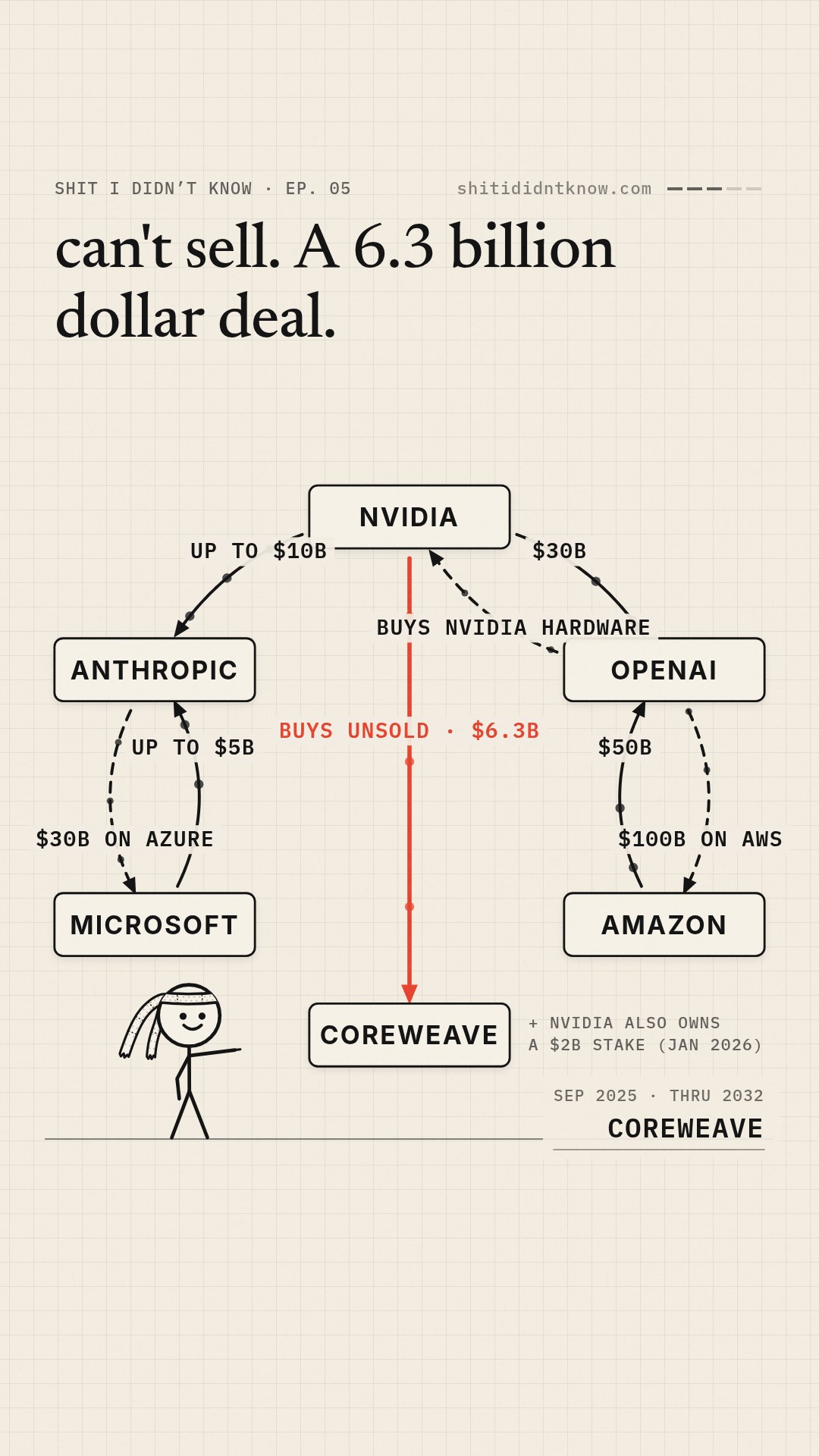
Nvidia invests in OpenAI. OpenAI buys Nvidia chips. AMD gives OpenAI its own stock for buying AMD chips. Nvidia promises to rent back whatever CoreWeave can’t sell. That’s the loop, and this week the bill started to show.
TechCrunch tallied the four companies’ 2026 plans at $740 billion, using the top of each range it had. The tops it prints are Alphabet up to $205 billion, Amazon about $220 billion, and Meta as much as $145 billion. It does not print Microsoft’s annual guide on its own.1 The BIS chart, taken from what five companies told investors, puts them above $800 billion and adds Oracle.3 The same week, Alphabet’s own earnings call put free cash flow for the third quarter at negative $9.1 billion. Capex that quarter was $51.4 billion.12
Or just watch it · 1:16
Rather watch? Here's the whole thing in under a minute.
Same rabbit hole, told by TP, in your pocket.
Three words that are not the same event.
For a kid
Company A gives Company B money and calls it an investment. Company B spends money, quite possibly that money, on Company A’s product. Company A’s sales go up. Sometimes a stranger really wanted the product. Sometimes the only reason B can write the order is that A just handed B the cash.
A loop can move real chips and burn real electricity. It is not automatically a fraud. Fraud is a fake invoice for a thing that never existed. The question here is narrower. Does the sale prove that someone outside the circle wanted the thing?
How it actually works
Announced means a press release. “Intends to invest up to” is a ceiling. Nobody has written a check for the ceiling.
Committed means a contract. An order with an initial value. Someone is on the hook if the machines actually show up. The cash can still be in the future.
Spent means it left. Capex in an earnings release. Free cash flow after that spending. If a source says “up to” or “expects,” it is not this bucket.
The Bank for International Settlements, in an October 27, 2026 bulletin, says capital spending by the five largest US hyperscalers, Alphabet, Amazon, Meta, Microsoft, and Oracle, is expected to reach more than $800 billion by the end of 2026. That is about 2.5 percent of US GDP. The chart uses the amounts in the companies’ own communications, the top of what they told investors. Gross bond issuance by those five hit $222 billion by September 2026.3 TechCrunch’s $740 billion is four companies, not five.
Go nerdier open if you want the footnotes of the mechanism
Free cash flow is what is left after the building bill. It is not profit, and each company subtracts a slightly different list. Alphabet’s third quarter is the clean example because the company said it out loud: operating cash flow $42.3 billion, capex $51.4 billion, free cash flow negative $9.1 billion. The call also blamed an inventory build for TPU sales and a $5.2 billion payment of an old European Commission fine. The full-year capex guide stayed $195 to $205 billion.2 TechCrunch has the negative $9.1 billion, the $51.4 billion, and the “up to $205 billion.”1
Amazon told investors to expect about $220 billion of capex this year. TechCrunch and CNBC both reported that, and both reported trailing free cash flow of negative $42.4 billion.14 Meta is guiding to as much as $145 billion. TechCrunch said negative free cash flow of $2.1 billion in the quarter. CNBC said $2.12 billion. Same quarter, two roundings.14 Microsoft’s quarter was still positive: TechCrunch reported $18.6 billion of free cash flow and $45.2 billion of capex. CNBC’s figure for the cash flow is $18.63 billion. Amazon’s negative $42.4 billion is a trailing-year number, not that same quarter.14
Follow the dollar Announced amounts, not a receipt
$
- NvidiaPuts in $30 billion
- OpenAISays the deal comes with 3 gigawatts
- AMDHands over its own stock
- CoreWeaveNvidia rents back the leftovers
February 27, 2026. OpenAI said Nvidia was putting $30 billion into a $110 billion round. The September letter, up to $100 billion, is the deal that got put on ice.
Four announced loops. None of these is a receipt.
Next to older buildouts Only the bars that share a unit
Railroads, 1854 2.6% of GDP
Five hyperscalers, expected 2026 about 2.5% of GDP
Railroads: one peak year, net of wear (William & Mary). AI: five companies' top-end plans (BIS).
Telecom service companies spent $121 billion on capital projects in 2000, the San Francisco Fed's figure. That is dollars, not a share of GDP, so it is not a third bar.
The circle, with the dates on it.
On September 22, 2025 Nvidia and OpenAI published a letter of intent. Nvidia intends to invest up to $100 billion, a gigawatt at a time, as at least 10 gigawatts of Nvidia systems get deployed. The first gigawatt was aimed at the second half of 2026. Both companies said the details were not finished.56 Reuters reported the “up to $100 billion” and the chip supply.7 A ceiling is not a receipt.
On January 30, 2026, The Wall Street Journal reported the $100 billion deal was on ice. Reuters and the FT confirmed it. By February 27 it had shrunk to a $30 billion stock purchase, and the FT reported OpenAI would spend much of its new money on Nvidia hardware.82324 OpenAI says the Nvidia deal comes with 3 gigawatts of inference, and the same post adds 2 gigawatts of training on Vera Rubin. Reuters the same day reported the $110 billion round, Nvidia’s $30 billion, and Amazon’s $50 billion.910 Still announced. Still not the September ceiling.
The signed version of the loop is smaller and older. On September 9, 2025 CoreWeave filed an order form with Nvidia, initial value $6.3 billion. If CoreWeave’s own customers do not fill the capacity, Nvidia buys the unsold remainder through April 13, 2032, provided the capacity is actually delivered. The filing also says Nvidia supplies the GPUs and is a stockholder. Reuters and CNBC both reported the order.111225 Chip vendor, investor, and the buyer of last resort.
AMD did the loop with stock instead of a rent-back. On October 6, 2025 AMD and OpenAI announced 6 gigawatts of AMD GPUs. AMD gave OpenAI a warrant for up to 160 million AMD shares at one cent each, vesting as OpenAI buys, with the first slice after 1 gigawatt and the rest as the purchases go to 6. The filing also ties later slices to AMD’s share price and to technical milestones. The chip seller hands the buyer its own stock for buying its chips.2627
Microsoft and Nvidia did a version of it with Anthropic on November 18, 2025. Nvidia said it would invest up to $10 billion, Microsoft up to $5 billion, and Anthropic committed $30 billion of Azure compute.2829 Amazon’s turn is a compute contract first and a check later. On November 3, 2025 OpenAI said it was committing $38 billion to use AWS. On February 27, 2026 OpenAI said Amazon was putting $50 billion into the new round.3010
On August 10, 2026 Nvidia signed memorandums with Apollo, BlackRock, Blackstone, Brookfield, Goldman Sachs, and KKR to raise more than $500 billion of other people’s money for AI factories. Nvidia says it may cover up to 25 percent of a project’s residual value, project by project. The partnerships were still waiting on final agreements.3132
Microsoft and OpenAI are the kindergarten version. On July 22, 2019 Microsoft said it was investing $1 billion. Reuters reported that figure the same day. OpenAI’s post says Microsoft will become the exclusive cloud provider. That sentence is OpenAI’s, and it is in the future tense.1314 On January 23, 2023 they extended the deal and still did not publish a number. Reuters said Microsoft would not comment on the terms.1516 The UK competition authority later recorded a $10 billion investment that January, and said the 2019, 2021, and 2023 agreements total $13 billion. A 2021 check in that document is redacted. Do not invent it by subtraction.17
Who is writing the big checks.
Two counts of one borrowing binge: S&P says $326 billion of debt this year; the BIS counts $222 billion in bonds through September.13 TechCrunch is the one citing S&P. The BIS counted the bonds itself, through September 22.
The catches.
Two totals, two clubs.
Four companies, $740 billion, is TechCrunch’s tally.1 Five companies, expected above $800 billion and about 2.5 percent of GDP, is the BIS. The fifth name is Oracle, and the chart uses the top of what they told investors.3 Adding the two totals double-counts.
Negative free cash flow is not bankruptcy.
Alphabet still reported $42.3 billion of operating cash flow that quarter, $179.6 billion over the trailing year, and $265.1 billion of cash and securities. Operating cash flow minus that quarter’s capex is the negative $9.1 billion. The company also pointed at an inventory build and a $5.2 billion fine. Those are already inside the published number.2
The railroad comparison is almost rude.
In 1854, America’s railroad peak, the country put about 2.6% of GDP into track, net of wear. This year five tech companies are on pace for about 2.5%, the top of their plans. One estimate cited by the BIS says data centers will average 3.2% a year through 2032, bigger than the railroads.193 A different 1870s statistic, railroads as a share of all capital spending, is about 20 percent. That one is not a share of GDP.20
The fiber bust was real, and it was dollars.
The San Francisco Fed put capital spending by publicly traded telecom service companies at $121 billion in 2000, up from $47 billion in 1995, then down to $49 billion by 2002. WorldCom and Global Crossing are in that wreckage.21 This page does not turn $121 billion into a GDP share. The bars above are only the figures that were already shares.
$2,165 is a division, not an invoice.
$740 billion divided by 341,784,857 people (Census, July 1, 2025). That’s if all four hit the top of what they told investors. It’s not what you owe. Split $800 billion the same way and you get about $2,341. Only that second number belongs to the $800 billion. The BIS itself says more than $800 billion.1318
A buildout and a bubble can be the same picture.
The steel-and-concrete case is not silly. TechCrunch reports Amazon’s AWS revenue grew 39 percent in the quarter it was writing about. Demand for at least that cloud is not a rumor.1 Railroads were real. A lot of the track got used. A lot of the companies that laid it went broke anyway. Fiber in the ground from 2000 is still carrying traffic. The firms that borrowed to bury it did not all survive.21
The bubble case is the circle plus the cash. If the buyer’s order is funded by the seller, the revenue is not a census of strangers. CoreWeave’s filing is the plain version: Nvidia sells the chips, owns stock, and agrees to buy leftover cloud time.11 Alphabet’s quarterly free cash flow going negative, and the five of them issuing $222 billion of bonds by September, is what it looks like when the buildout no longer fits in the cash the business just produced.23 Bloomberg’s map of the 2026 deals draws the same distinction this page is using. A circular contract can be a real delivery. A round-trip is a sham booked so both sides can show a sale.22
Where this page lands. The machines are real, and the tab is real. The loop makes the demand harder to trust than a normal sales number. That is not a forecast that it all crashes, and it is not a forecast that it all pays off. It is a reason to read “up to” as a ceiling and “expects” as a plan. Nothing here is a suggestion to buy, sell, or short a share of any of it.
The guides and the circles landed in the same season.
October 2026 is when TechCrunch tallied the four plans at $740 billion, the top of the ranges, and when Alphabet put a negative free-cash-flow quarter on its own call.12 On October 31 the Financial Times reported, and CNBC confirmed, that OpenAI had cut the target for its current round to about $20 billion from about $30 billion. The round was still open.33 Five days earlier Anthropic filed with the SEC to go public.34 The September 2025 letter, up to $100 billion, is already an old document next to the February announcement of $30 billion from Nvidia.59 The bond market is in the story too: $222 billion by September, on the BIS count.3
The useful habit is the buckets. Announced, committed, spent. A guide is not capex. A letter is not a wire. A per-person split of a national guide is not your bill. The circle is the part worth remembering, because it is the part a headline smoothes out.
The documents, not a thread.
- TechCrunch, October 30, 2026
The four-company guide, and the quarter the cash flow went red for Alphabet.
- Alphabet’s third-quarter call
Negative $9.1 billion, in the company’s own words, with the fine and the inventory.
- BIS Bulletin 140
The five-company total, the GDP share, and the bonds.
- Bloomberg’s map of the circles
Why a circular deal is not the same thing as a fake round-trip.
- CoreWeave’s 8-K
The $6.3 billion order and the unsold-capacity promise.
- The San Francisco Fed on the telecom bust
$121 billion of telecom capex in 2000, and what happened after.
Every loud number, and who said it.
- Rebecca Bellan, “Cracks are emerging in the AI spending boom,” TechCrunch, October 30, 2026. More than $740 billion of 2026 capex across Alphabet, Amazon, Meta, and Microsoft. Alphabet free cash flow negative $9.1 billion, capex $51.4 billion, guide up to $205 billion. Amazon about $220 billion and trailing free cash flow negative $42.4 billion. Meta as much as $145 billion and quarterly free cash flow negative $2.1 billion. Microsoft free cash flow $18.6 billion, capex $45.2 billion. AWS revenue up 39 percent. S&P figure of $326 billion of debt. TechCrunch.
- Alphabet third-quarter 2026 earnings call. Operating cash flow $42.3 billion in the quarter and $179.6 billion trailing. Capex $51.4 billion. Free cash flow negative $9.1 billion. Inventory build and a $5.2 billion EC fine payment. Cash and securities $265.1 billion. Capex guide $195 to $205 billion, unchanged. Alphabet IR.
- Mathias Drehmann and Egemen Eren, BIS Bulletin 140, “Building AI on credit: structures and spillovers,” October 27, 2026. Five largest US hyperscalers expected above $800 billion of capex by the end of 2026, about 2.5 percent of US GDP. The chart uses the amounts in the companies’ own communications. The five are Alphabet, Amazon, Meta, Microsoft, and Oracle. Gross bond issuance $222 billion by September 22, 2026. Footnote 1 cites Van Nieuwerburgh (2026): US data-center investment nearly $9 trillion over 2025–32, about 3.2 percent of GDP a year, more than the railroad, electrification, and telecom booms. BIS.
- CNBC, October 30, 2026, on the same earnings week. Amazon capex $220 billion and trailing free cash flow negative $42.4 billion. Meta capex as high as $145 billion and free cash flow negative $2.12 billion. Microsoft free cash flow $18.63 billion. CNBC.
- Nvidia newsroom, September 22, 2025. Letter of intent. Up to $100 billion. At least 10 gigawatts. First phase aimed at the second half of 2026. Details still open. Nvidia.
- OpenAI, the same announcement, September 22, 2025. OpenAI.
- Reuters, September 22, 2025. Up to $100 billion and a supply of data-center chips. Reuters.
- Berber Jin and Robbie Whelan, “The $100 Billion Megadeal Between OpenAI and Nvidia Is on Ice,” The Wall Street Journal. Reuters’ story is datelined January 30, 2026 (“reported on Friday”); the Journal’s page was updated January 31. WSJ.
- OpenAI, “Scaling AI for everyone,” February 27, 2026. $110 billion, including $30 billion from Nvidia, $30 billion from SoftBank, and $50 billion from Amazon. OpenAI says the Nvidia piece comes with 3 gigawatts of inference and 2 of training on Vera Rubin. OpenAI.
- Reuters, February 27, 2026. The $110 billion round, Nvidia’s $30 billion, and Amazon’s $50 billion. Reuters.
- CoreWeave Form 8-K, September 9, 2025. Order initial value $6.3 billion. Unsold capacity through April 13, 2032, subject to delivery. Nvidia supplies GPUs and is a stockholder. SEC.
- Reuters, September 15, 2025. The $6.3 billion order and the unsold-capacity guarantee. Reuters.
- OpenAI, July 22, 2019. Microsoft investing $1 billion. Exclusive cloud is this post’s sentence. OpenAI.
- Reuters, July 22, 2019. Microsoft investing $1 billion. Reuters.
- OpenAI, January 23, 2023. Multibillion, no figure. OpenAI.
- Reuters, January 23, 2023. Multibillion. Spokesperson declined to comment on terms. Reuters.
- UK Competition and Markets Authority decision. $10 billion in January 2023. Agreements through 2023 totalling $13 billion. A 2021 amount is redacted. gov.uk.
- US Census Bureau, Vintage 2025. Resident population 341,784,857 on July 1, 2025. The January 27, 2026 release rounds the same estimate to 341.8 million. QuickFacts, press release.
- William & Mary working paper, railroads and antebellum growth. Net railroad capital formation, Fishlow’s series net of depreciation, peaked at 2.6 percent of GDP in 1854. PDF.
- Melville J. Ulmer, railroad capital formation, NBER. 1870–1879 railroad gross capital formation was 20.1 percent of total US gross capital formation. Not a GDP share. NBER.
- Federal Reserve Bank of San Francisco, “The Boom and Bust in Information Technology Investment.” Telecom service capex $47 billion in 1995, $121 billion in 2000, $49 billion in 2002. FRBSF.
- Bloomberg, “AI Circular Deals,” 2026 graphic. A circular deal is an investment in a customer that buys the investor’s product. It is not the same as a sham round-trip. Bloomberg.
- Reuters, January 30, 2026. Nvidia’s plan to invest up to $100 billion had stalled, citing the Journal. Reuters.
- George Hammond and Michael Acton, Financial Times, February 20, 2026, via the Financial Post. The unfinished $100 billion deal was being replaced by a $30 billion investment, and “OpenAI will reinvest much of its new capital into Nvidia hardware.” Financial Post.
- CNBC, September 15, 2025. CoreWeave disclosed Nvidia’s $6.3 billion order. CNBC.
- AMD, October 6, 2025. Six gigawatts of AMD GPUs. A warrant for up to 160 million shares, vesting with the purchases. AMD. Reuters the same day: Reuters.
- AMD Form 8-K, warrant issued October 5, 2025. Up to 160 million shares at $0.01. First tranche after 1 gigawatt of MI450 GPUs. Full vesting contingent on 6 gigawatts, plus share-price targets up to $600 and technical conditions. Expires October 5, 2030. SEC.
- Anthropic, November 18, 2025. Anthropic commits $30 billion of Azure compute. Nvidia up to $10 billion, Microsoft up to $5 billion. Anthropic.
- Reuters, November 18, 2025. The same Azure commitment and the same two investment ceilings. Reuters.
- OpenAI, November 3, 2025. A $38 billion agreement to run workloads on AWS. OpenAI. Reuters: Reuters.
- Nvidia, August 10, 2026. Memorandums with Apollo, BlackRock, Blackstone, Brookfield, Goldman Sachs, and KKR to mobilize over $500 billion of third-party capital. Subject to final agreements. Nvidia.
- Nvidia’s August 11, 2026 note: residual-value support for up to 25 percent of an opportunity, project by project. Reuters the day before, quoting Jensen Huang: an option to backstop up to 25 percent. CNBC the same day on the six firms and the $500 billion. Nvidia, Reuters, CNBC.
- CNBC, October 31, 2026, confirming a Financial Times report. OpenAI cut the target for its current round to about $20 billion from about $30 billion. The round had not closed. CNBC.
- Anthropic, October 26, 2026. Filed a Form S-1 for a proposed IPO of Class A shares, to be listed on Nasdaq as ANT. Share count and price not set. Anthropic.
Newsletter
Get the next rabbit hole before everyone else.
Just a quick email when a new rabbit hole drops. If you were on the old Substack, you're already on it.