shit i didn't know Fall down a rabbit hole with TP.
Rabbit hole No. 004 · New

The yen carry trade is free money with a trapdoor

Borrow yen for almost nothing, park it where it pays 4 or 5 percent, keep the difference. It works for years. Then one Monday in August 2024 it took Japan's stock market down 12 percent.

There’s this trade that sounds like a scam. It isn’t. You borrow money in Japan, where it’s been almost free for decades. You swap it into dollars and park it somewhere that pays 4 or 5 percent. You pocket the gap. Every day. For years.

It has a name, the yen carry trade, and nobody knows exactly how big it is. On Monday, August 5, 2024, a chunk of it tried to leave at the same time, and Japan’s main stock index fell 12.4 percent in a day. The worst day since 1987.2425 Then it bounced back 10 percent the next day, like nothing happened.2627

I kept seeing “carry trade unwind” in headlines and nodding along like I knew what it meant. I did not. Turns out it’s one of the simplest trades in finance with one of the nastiest surprises hidden inside, and in 2026 it’s back in the news because Japan finally has real interest rates again.

Or just watch it · 1:13

Rather watch? Here's the whole thing in about a minute.

Same rabbit hole, told by TP, in your pocket.

The core idea

Borrow cheap, park it somewhere that pays.

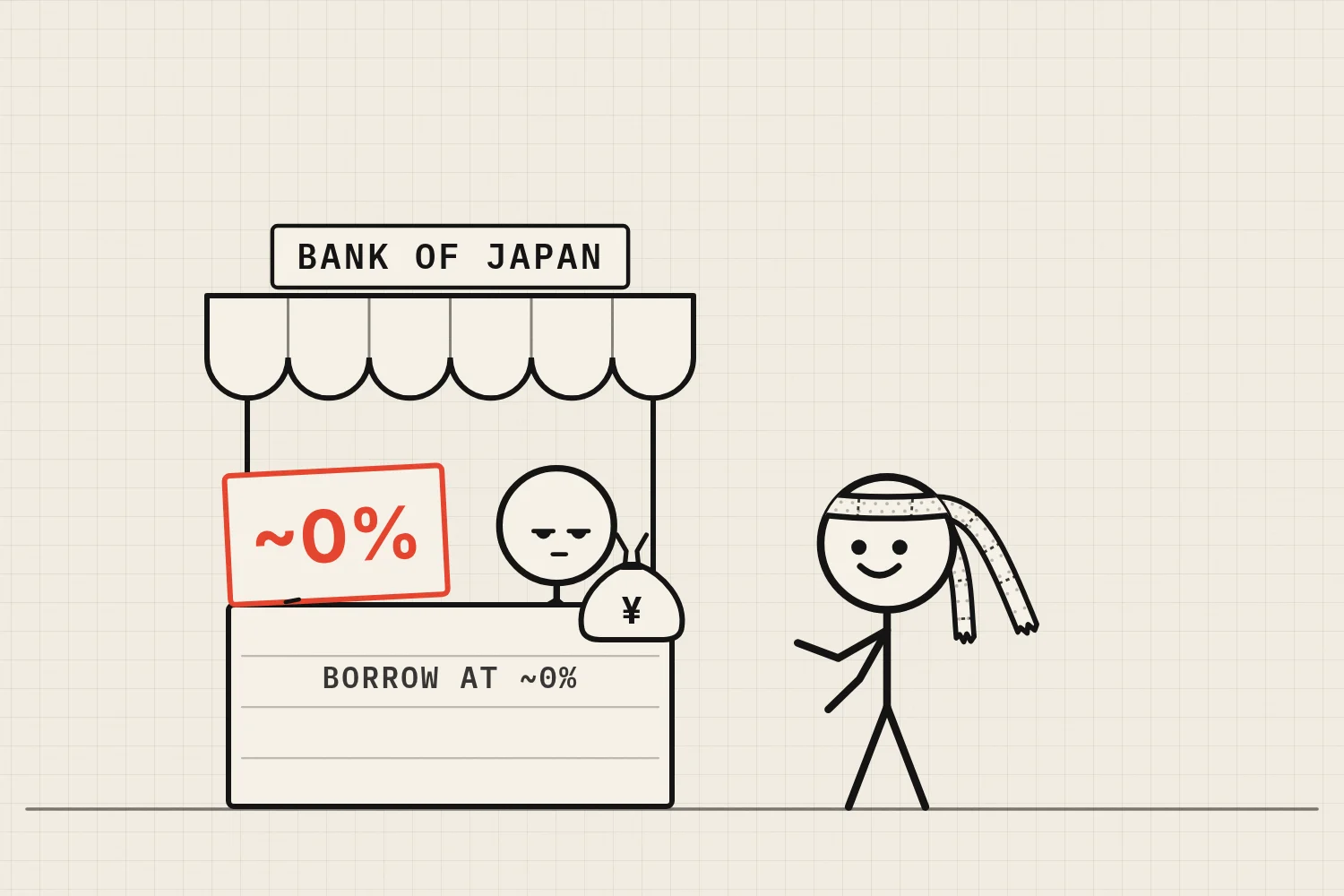
TP borrows a sack of yen from a sleepy Bank of Japan stall offering about 0 percent.
Step 1: Borrow yen for almost nothing.
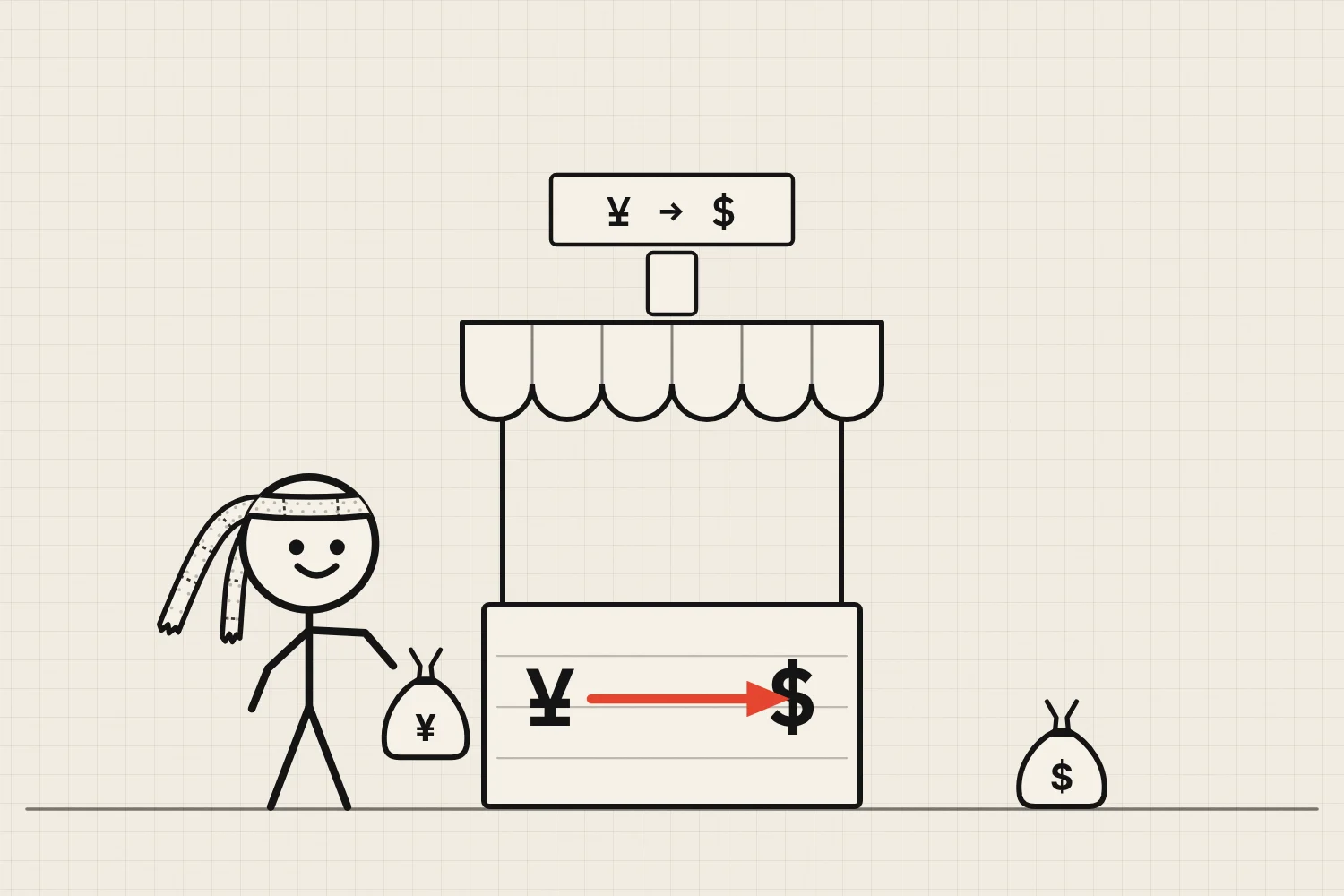
TP swaps the yen sack for a dollar sack at a currency booth.
Step 2: Swap it into dollars.
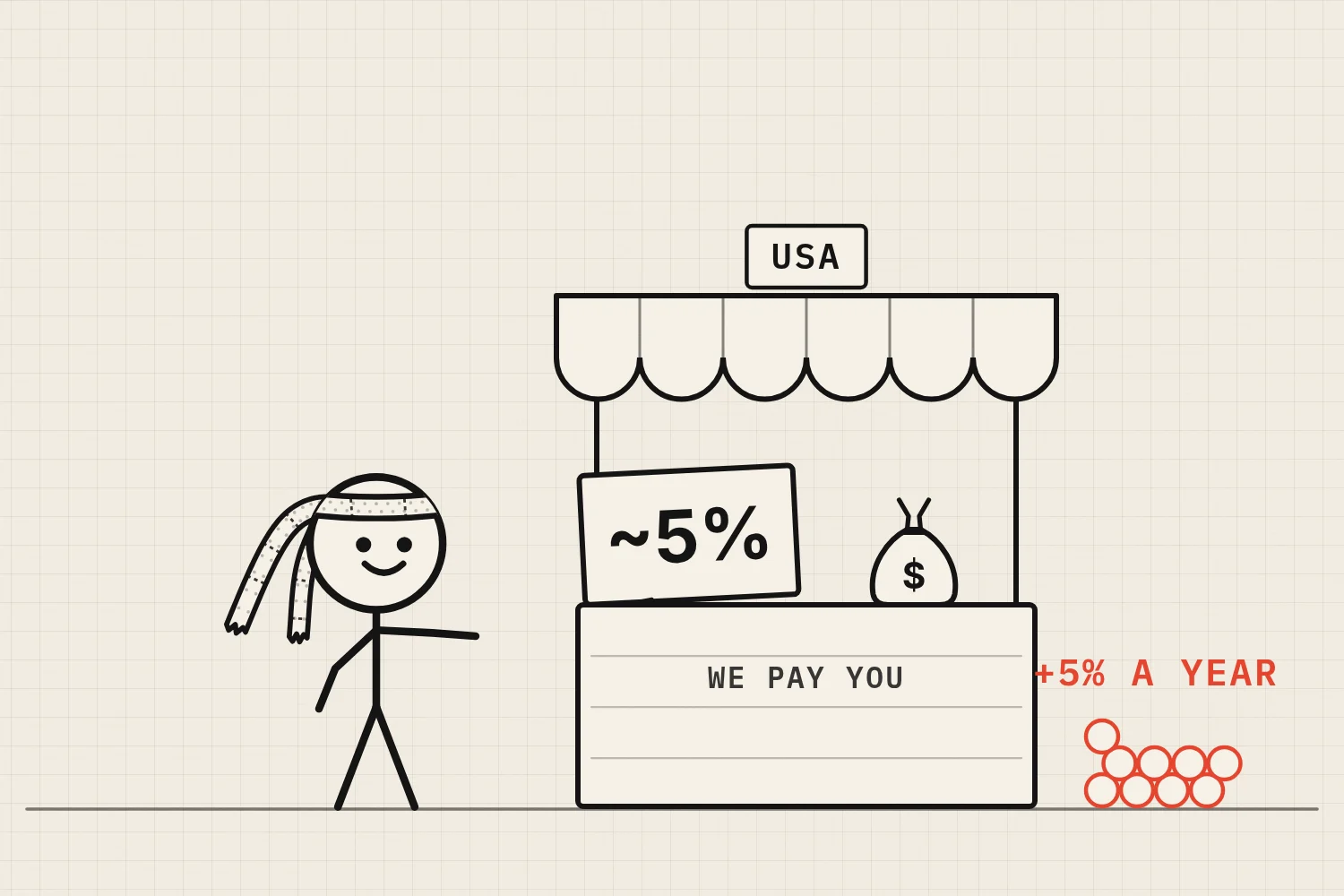
TP deposits the dollars at a US stall paying about 5 percent, and a small coin pile grows.
Step 3: Park it where it pays about 5 percent (2024).
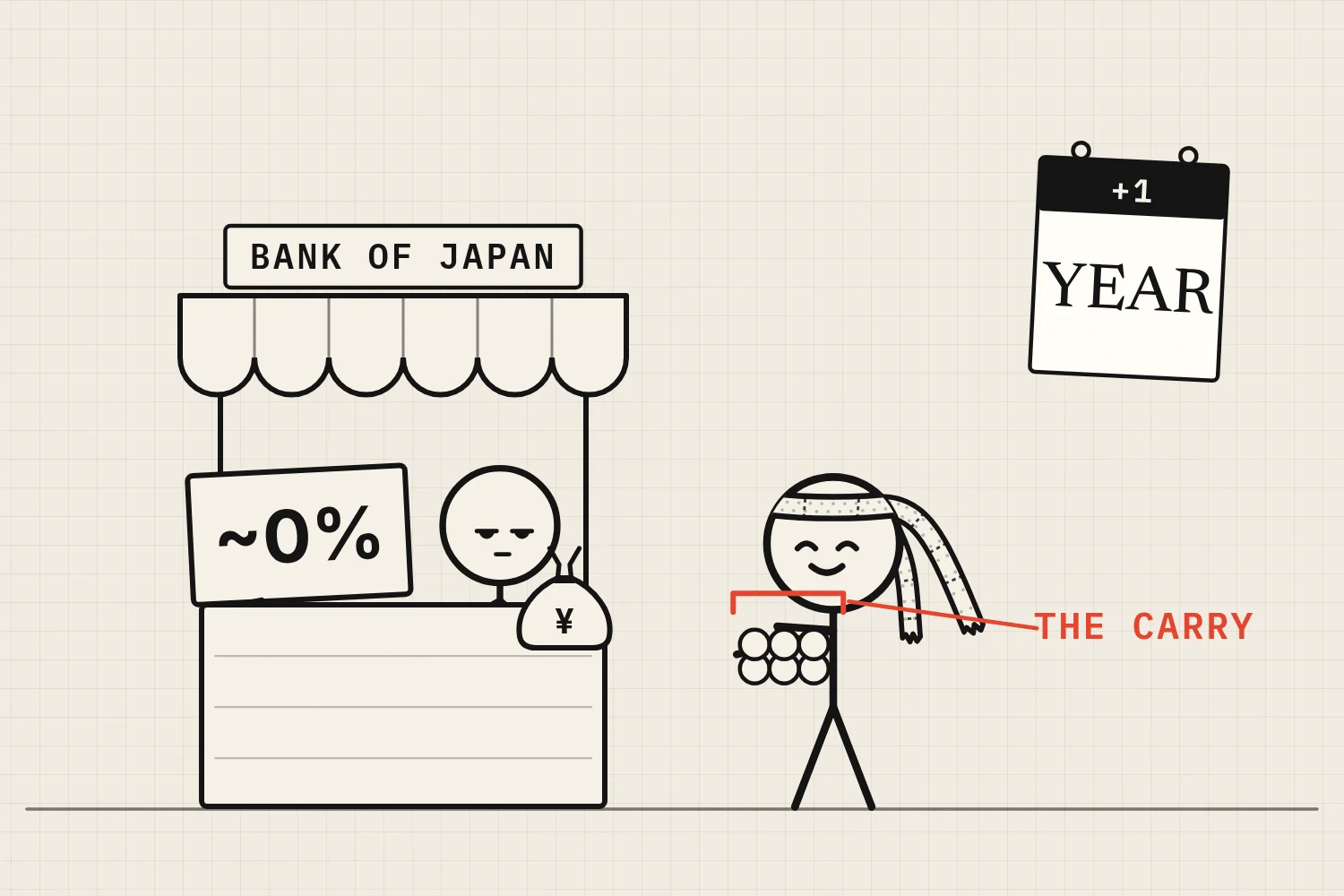
TP returns the yen loan and keeps the pile of interest, labeled the carry.
Step 4: Pay back the yen. Keep the difference. That difference is the carry.
For a kid

Imagine your aunt lends you $1,000 and says “pay me back next year, no interest.” You put it in a savings account that pays 5 percent. A year later you hand her back $1,000 and keep $50. You did nothing. That’s the whole trade.

Now make the aunt the Bank of Japan, make it billions, and add one twist. The aunt lent you yen, and she wants yen back. That twist is the trapdoor. The rest of this page is basically about that one sentence.

How it actually works

Every country’s central bank sets a basic interest rate, the price of borrowing money there for a short time. For most of the last 30 years Japan’s was close to zero. From 2016 until March 2024 it was actually negative, minus 0.1 percent.1415 Meanwhile in the US, the Federal Reserve had its rate at 5.25 to 5.50 percent through the summer of 2024.1819

So a hedge fund (a big pool of money run for rich people and institutions, usually allowed to take big risks) borrows yen at roughly nothing, sells the yen for dollars, and buys something that pays US rates, like Treasury bills (short IOUs from the US government, about as safe as it gets). The difference between what it pays and what it earns is the carry. In mid-2024 that gap was about 5 points a year.

Five percent a year doesn’t sound wild. So they borrow a lot. Put up $1 million of your own money, borrow ten times that, and your 5 percent on the borrowed pile turns into 50 percent on your own money. That’s leverage, using borrowed money to make a small edge big. It also makes a small loss big. Hold that thought.

Go nerdier open if you want the footnotes of the mechanism

Most of this doesn’t happen with a literal loan from a Japanese bank. The BIS (the Bank for International Settlements, basically the central banks’ central bank) says carry trades are often built with currency derivatives: forwards, swaps and options that give you the same “short yen, long something else” bet without anyone signing a loan. That’s one reason nobody can count it.28 In trader-speak, being “short yen” just means you’re on the hook to hand back yen later, so you win if the yen gets cheaper and lose if it gets pricier.

The yen isn’t the only cheap currency people borrow. On August 5, 2024, the BIS says, the yen rose the most of any currency, and the Swiss franc, another cheap-to-borrow favorite, came second. The currencies people had bought with that cheap money, the Mexican peso first, then the Brazilian real and South African rand, got hit hardest.28

The trapdoor

Your debt is in yen. The yen can move.

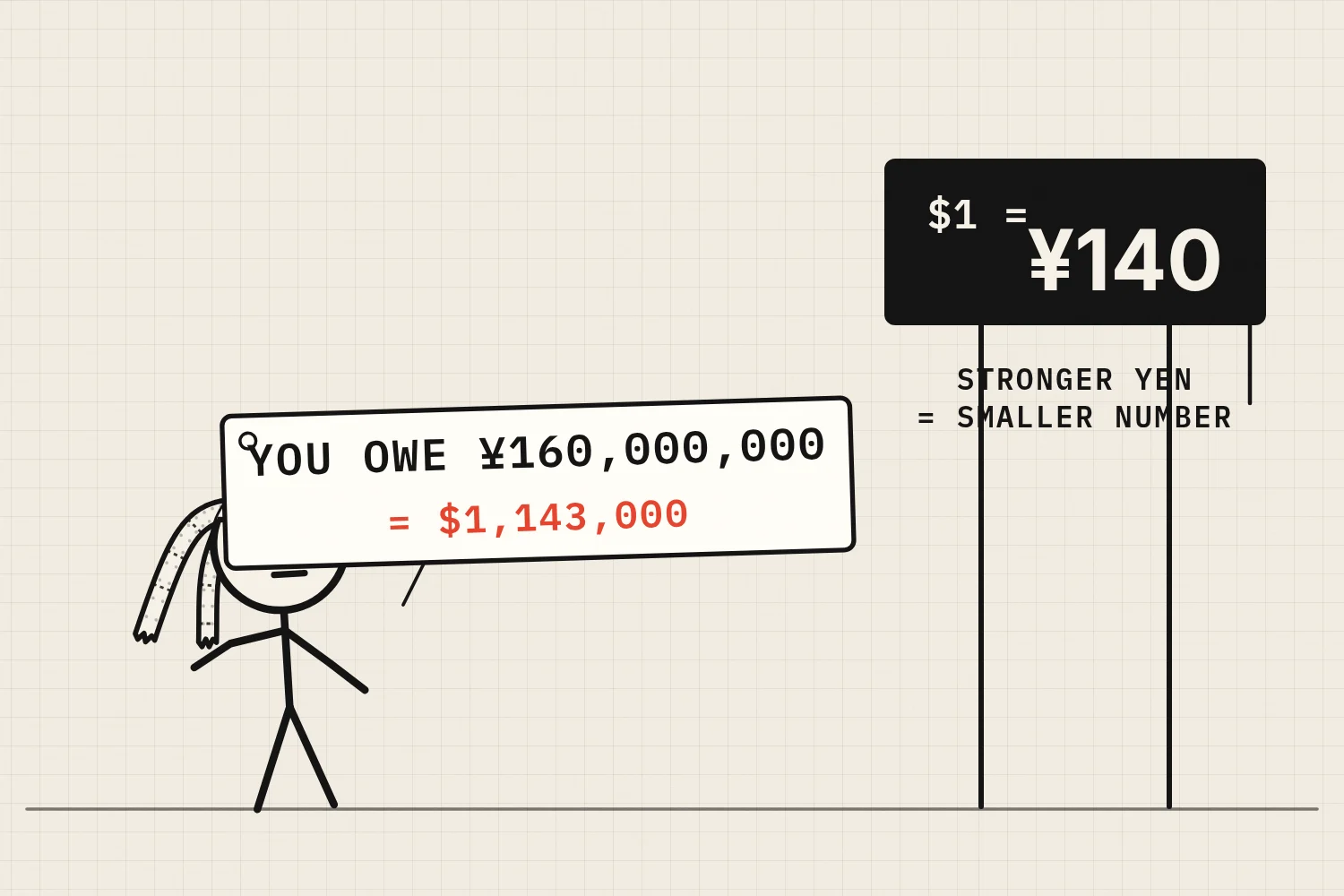
This part trips everybody up, me included, so I’m going slow. Exchange rates get quoted as “yen per dollar.” When it says 160, one dollar buys 160 yen. When the yen gets stronger, that number goes down, because a dollar now buys fewer yen. Stronger yen, smaller number. It feels backwards. It is backwards. Just remember it.

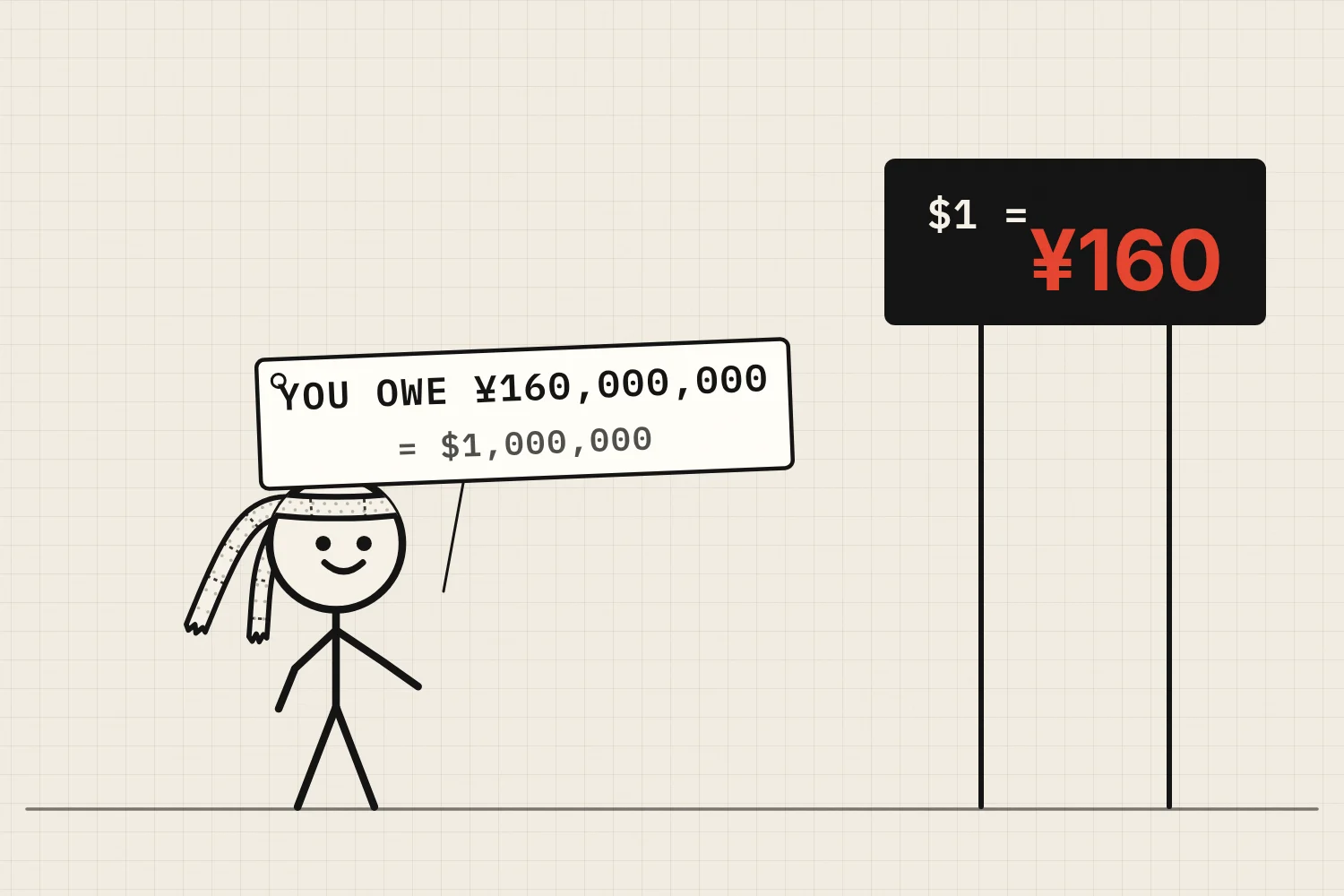
Now say you borrowed 160 million yen when the rate was 160. That’s $1 million. But your debt is written in yen, so what you owe is 160 million yen, whatever that costs later. If the yen strengthens to 140, paying back those same 160 million yen costs you about $1.14 million. Your debt grew about $143,000 and you didn’t borrow a cent more.

I picked 160 because it really happened. On July 3, 2024 the dollar bought 161.99 yen, the weakest the yen had been since 1986. By August 5 it bought 141.66.2223 Anyone short yen across that stretch saw their yen debt cost about 14 percent more in dollars. At a gap of about 5 points a year, that’s more than two years of carry gone in about a month.

TP holds a tag saying he owes 160 million yen, which is 1 million dollars at 160 yen per dollar.
Your loan is in yen. At 160 yen per dollar, ¥160 million is $1 million.
The rate board flips to 140 yen per dollar and TP's same yen debt now costs about 1.14 million dollars.
Same yen. The yen got stronger, so paying it back now costs about $143,000 more.
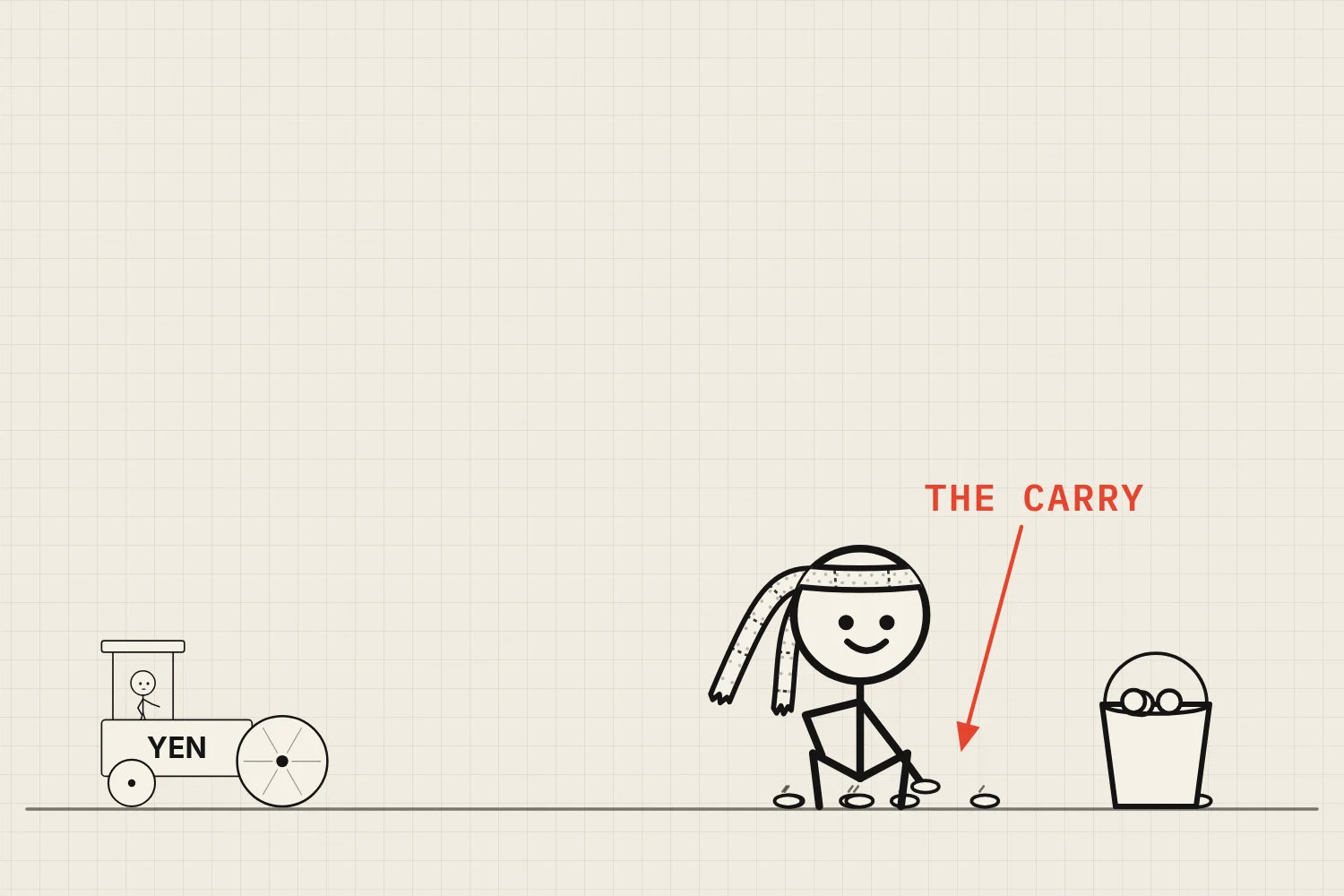
TP picks up pennies on a road while a yen steamroller sits far in the distance.
Most days, you just collect the pennies.
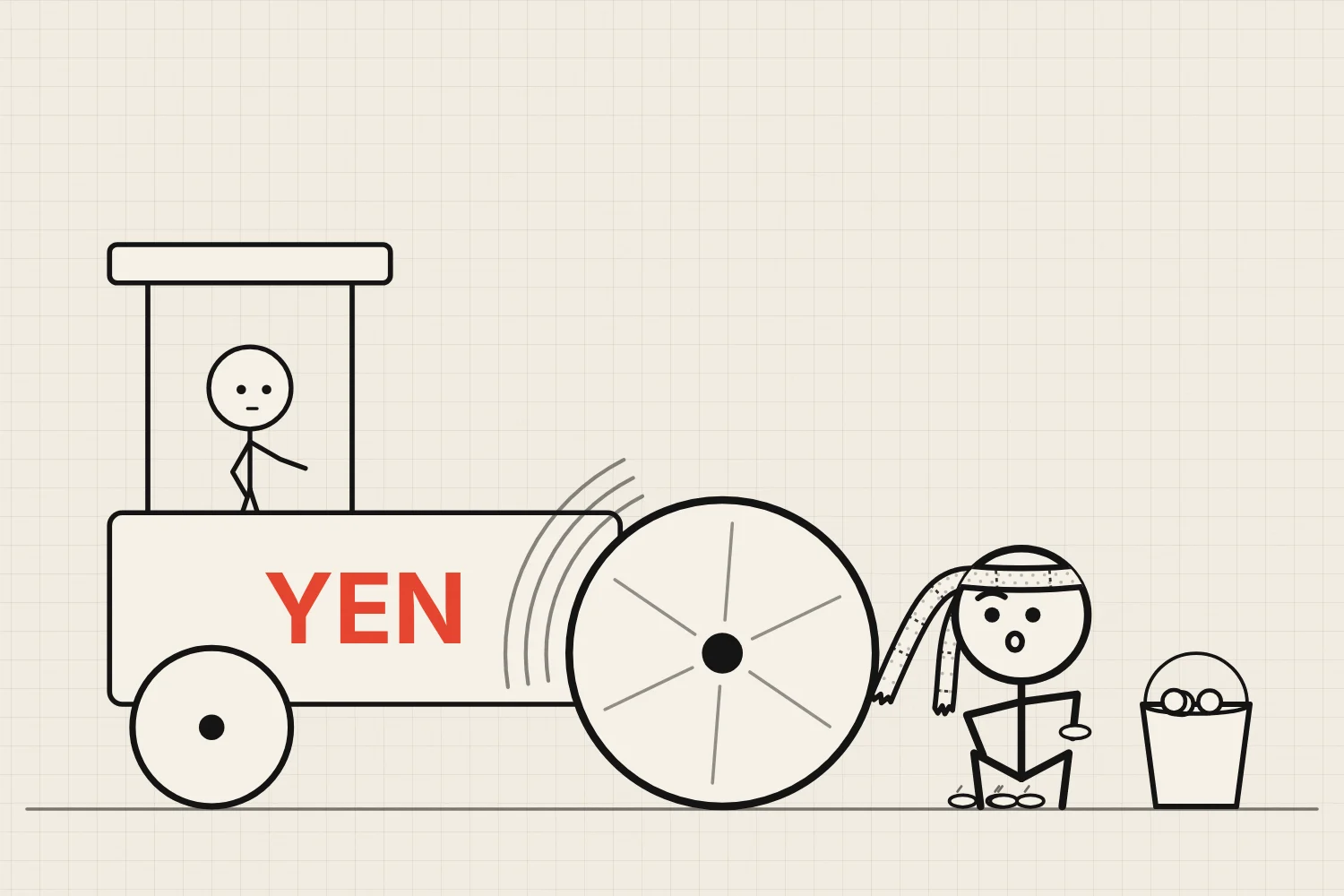
The yen steamroller is now right behind TP, who looks back calmly holding one penny.
Traders call this picking up pennies in front of a steamroller.

Traders have an old line for trades like this. Picking up pennies in front of a steamroller. You collect small, steady wins. The steamroller is slow and usually far away. Usually.

Borrow some yen Move the yen. Watch the debt.

That's ¥157,500,000 at 157.5 yen per dollar.

You put in $100,000. The rest is borrowed.

The gap is 2.6 points a year.

Smaller number = stronger yen = bigger debt. You borrowed at 157.5.

Breakeven is 153.5. If the yen gets stronger than this, the trade lost money.

Interest you earned $26,250

The gap, over the time you hold.

What the yen move did $0

The yen ended where you borrowed it.

Your total $26,250

26.3% of the $100,000 you put in.

A toy for understanding the idea. Not financial advice.

Swap pricing, fees, and actual deposit rates are left out.

August 2024

Everybody heads for the same tiny door.

For a while in 2024 the trade was printing money because the yen kept getting weaker. You earned the carry and your yen debt kept shrinking in dollar terms. Double win. Then, in less than a week, three things stacked up.

July 31. The Bank of Japan raised its rate to about 0.25 percent.1213 Tiny. But it was the second hike that year, and it told everyone Japan’s free-money era was ending. Your aunt started mentioning interest.

August 2. A weak US jobs report. Investors started asking out loud whether the US was heading into a recession. The S&P 500 lost 1.8 percent.2832

August 5. Monday in Tokyo. The Nikkei, Japan’s main stock index, fell 12.4 percent, closing at 31,458. That’s 4,451 points, the biggest point drop in its history, and the worst percentage day since Black Monday, the October 1987 crash.2425 The S&P 500 lost another 3 percent.28
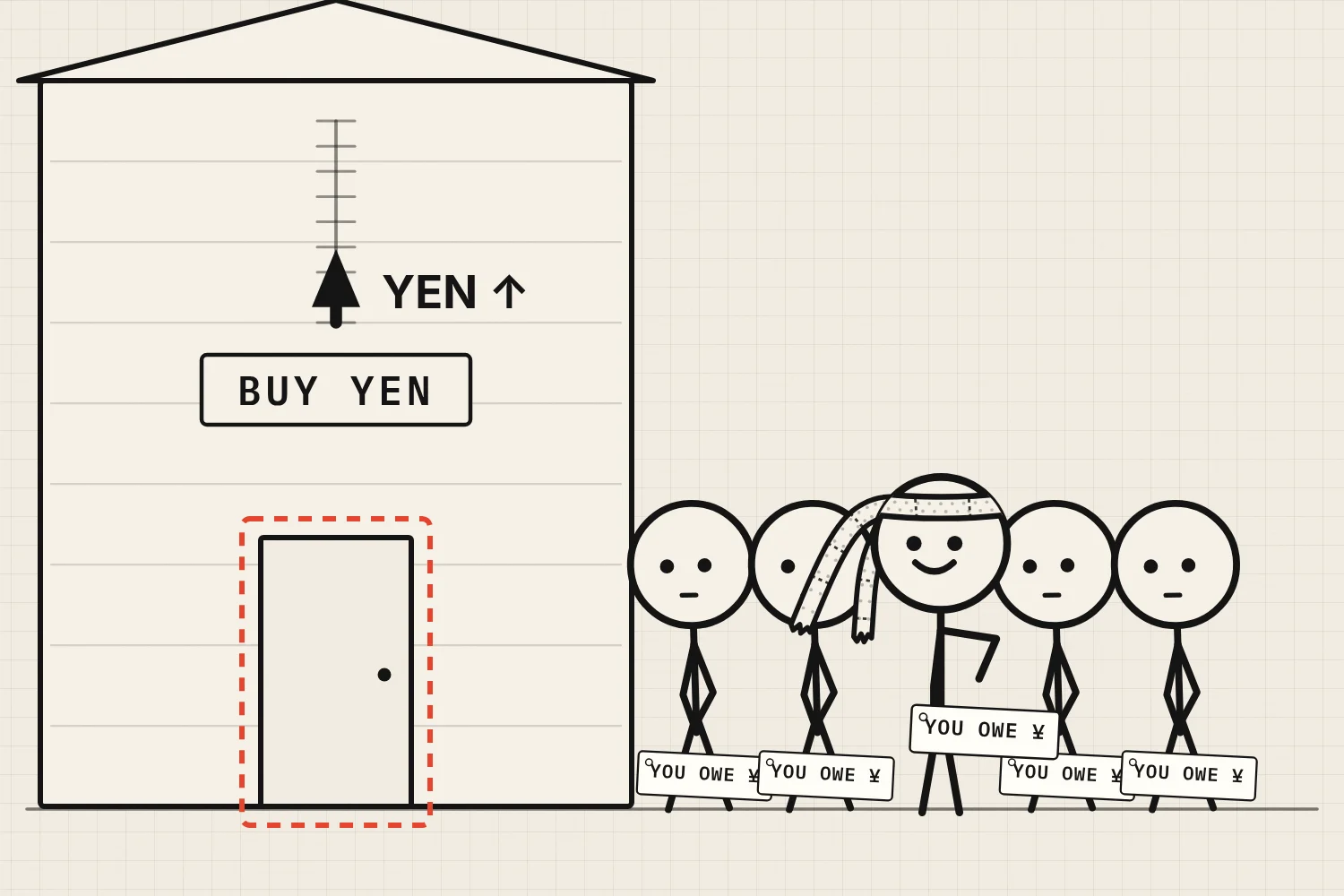
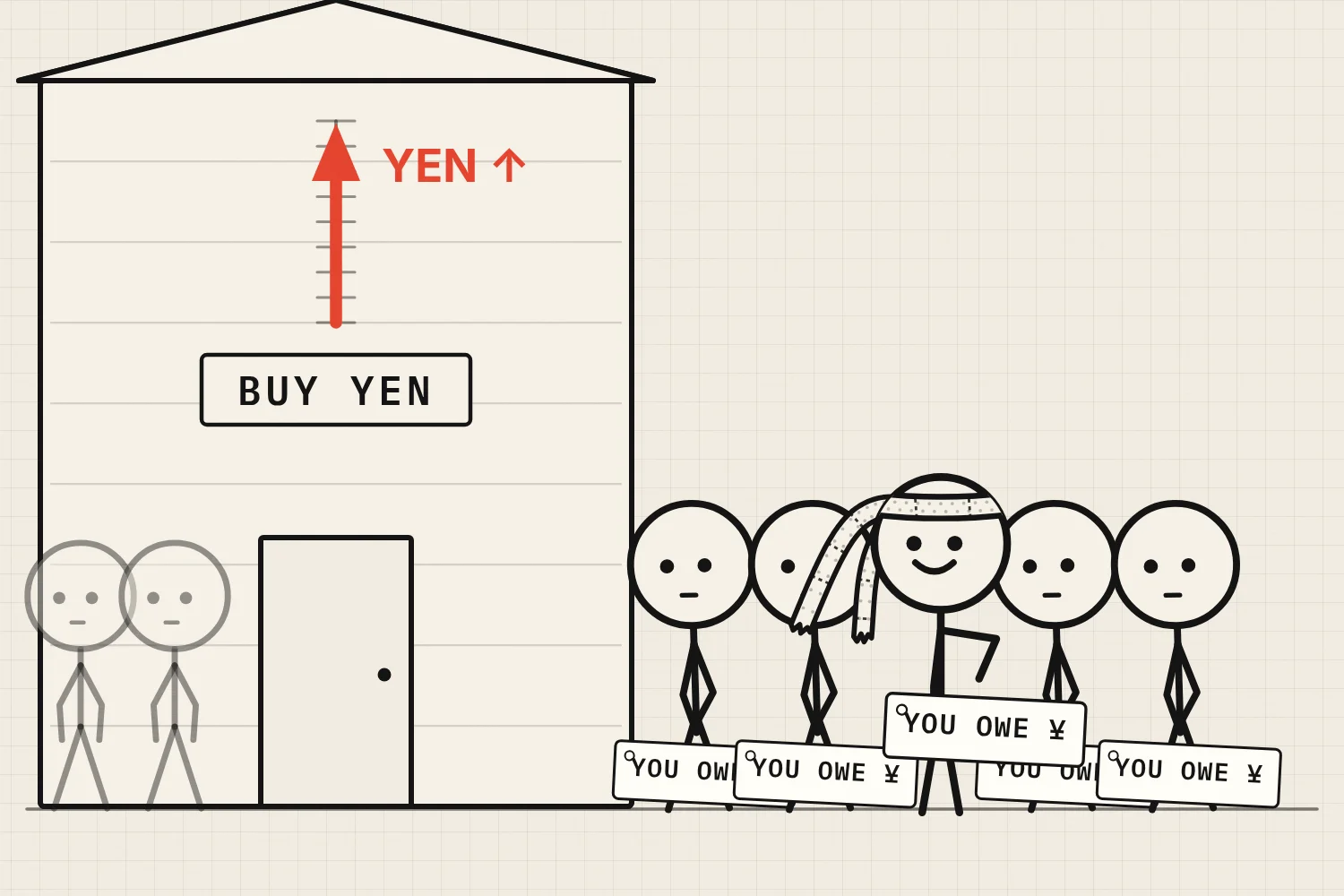
A crowd with yen debts, TP among them, lines up at one small door labeled buy yen.
To get out, you pay back yen. To pay back yen, you buy yen.
As people get through the door, the yen needle rises and everyone's debt tags grow.
Every buyer pushes the yen up, which makes everyone else's debt bigger. So more people rush the door.
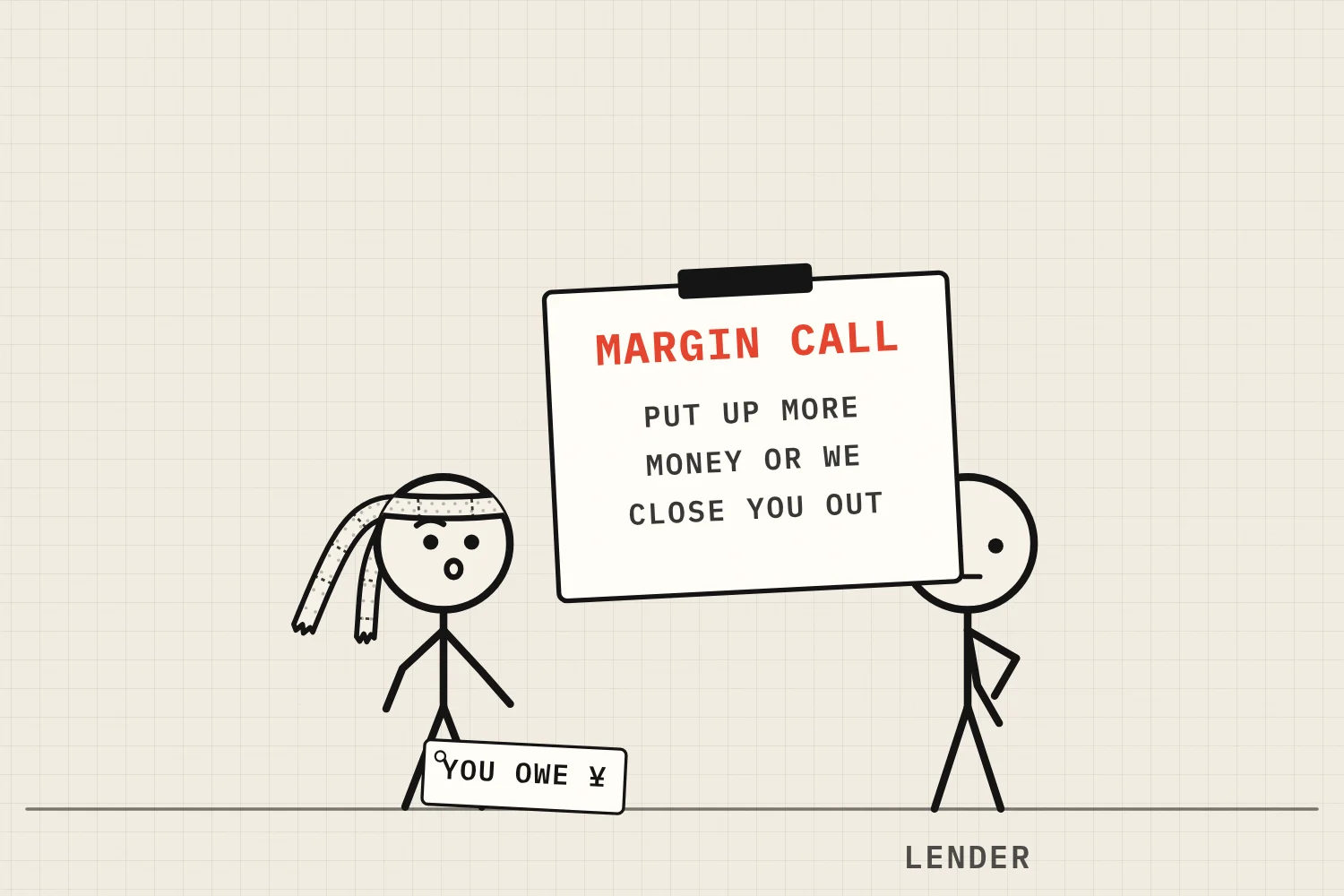
A lender with a clipboard tells TP he has a margin call.
Losses pile up, and the lender wants more money now. That's a margin call.
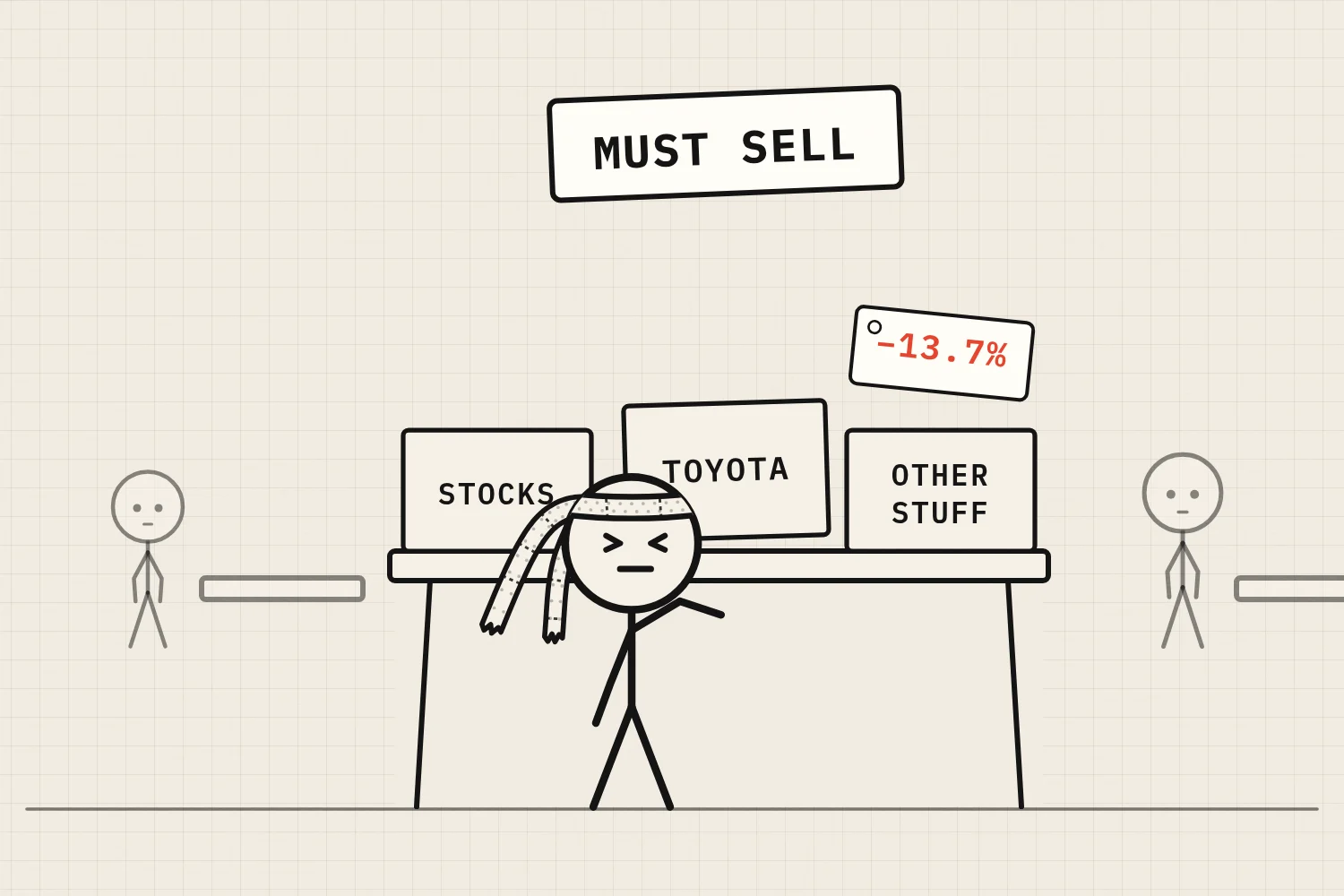
TP runs a must-sell yard sale of stocks, including a Toyota box tagged minus 13.7 percent.
So you sell whatever you can, even things that have nothing to do with yen. Toyota fell 13.7 percent that day.

Why would a Japanese rate hike plus a US jobs number crater Tokyo? Because of how you get out of a carry trade. To close it, you have to pay back the yen. To pay back yen, you buy yen. When thousands of traders do that at once, they push the yen up. A stronger yen makes everyone else’s yen debt bigger, which forces more of them out, which means more yen buying. The exit makes the fire bigger.

Then the losses hit, and lenders want more collateral, fast. That’s a margin call: “put up more money or we close your position for you.” To raise cash, people sell whatever they can sell, including stuff that has nothing to do with yen. The BIS says this forced selling, plus clearing houses (the middlemen that guarantee trades) suddenly demanding bigger deposits, made the whole thing worse.28 Japanese stocks got hit twice, because a stronger yen also shrinks what companies like Toyota earn abroad once it’s turned back into yen. Toyota’s shares fell 13.7 percent that day.2546

It wasn’t only hedge funds. Japan has a famous army of retail currency traders, regular people trading on margin from home, nicknamed “Mrs. Watanabe.” In aggregate they’d been short the yen too, and the BIS says their forced unwinding likely played a role.2835

Then it stopped almost as fast as it started. On August 6 the Nikkei jumped 10.2 percent, its biggest point gain ever.2627 On August 7 the Bank of Japan’s deputy governor, Shinichi Uchida, said out loud that the bank would not raise rates while markets were unstable.3334 By that Friday, the BIS says, the S&P 500 had made back the whole week’s losses.28
The numbers

The trade, by the digits.

Gap in mid-2024~5 pointsFed at 5.25 to 5.50 percent, Bank of Japan at 0 to 0.25.1812
Yen, July 3 to August 5, 2024162 → 142Yen per dollar. Over 12 percent stronger in about a month.22
Nikkei, August 5, 2024−12.4%Worst day since 1987. Then +10.2 percent the next day.2426
Gap today~2.6 pointsFed at 3.75 to 4.00 percent, Bank of Japan at 1.25.161

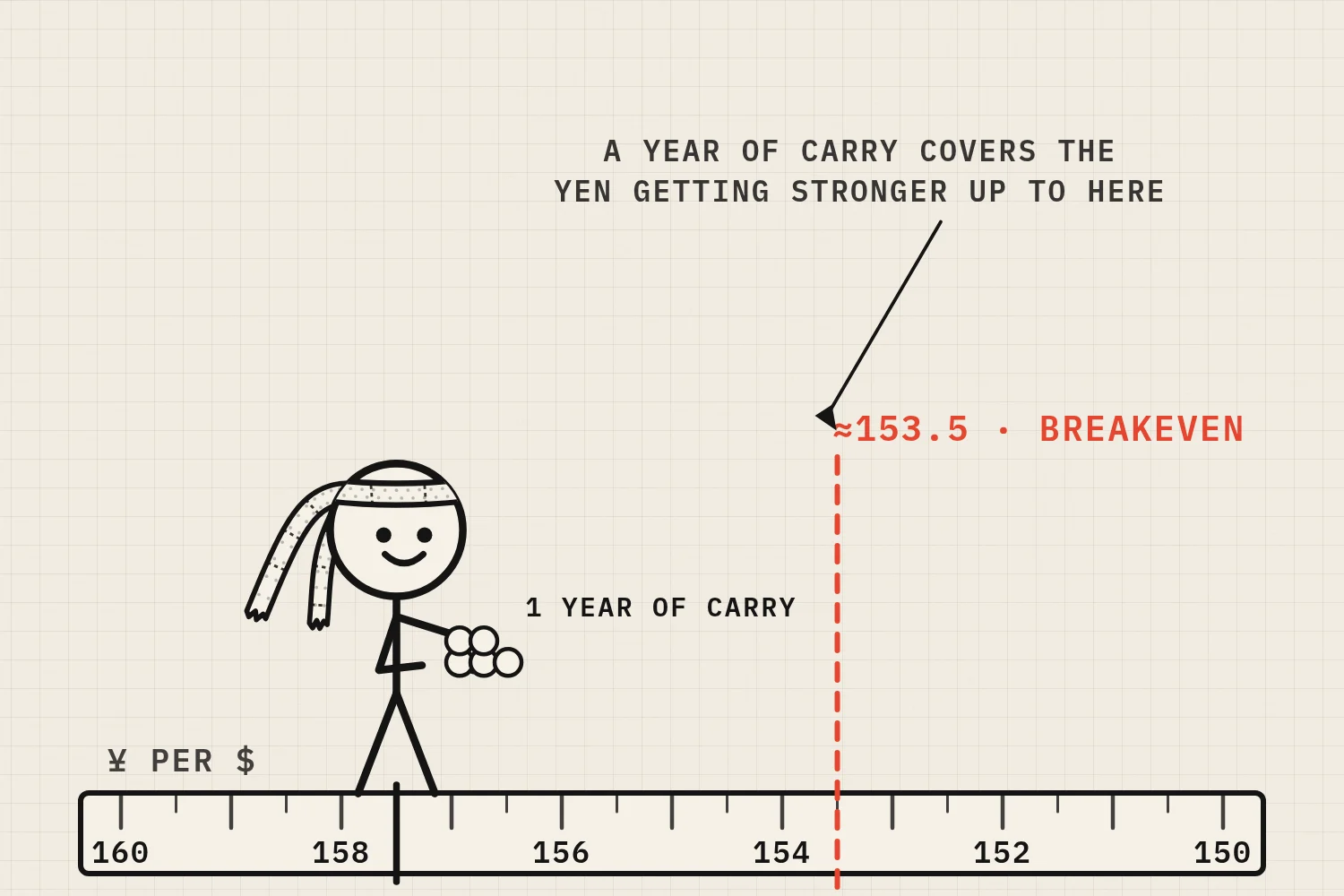
The gap today is about half what it was in 2024. That matters more than it looks. With a 2.6-point cushion, the yen only has to strengthen about 2.6 percent in a year to wipe out the whole year’s carry. That’s roughly 157.5 going to 153.5. Keep that number. It shows up again in September.

Wait, what?

The weird bits.

Wait, what?

Nobody knows how big it is.

The BIS’s rough middle estimate going into August 2024 was about ¥40 trillion, around $250 billion, and it said that was, “if anything, biased down.” A wider count of cross-border yen bank lending was over ¥80 trillion.2844 Other estimates run higher. A trade that can shake every market on Earth and that nobody can measure is my least favorite kind of fun fact.

Wait, what?

The fear gauge partly glitched.

The VIX, Wall Street’s “fear gauge,” jumped to about 65.7 before the US market opened on August 5, its biggest one-day spike ever. It closed at 38.6.3031 A later BIS study found the spike was inflated by how the VIX is calculated. It’s built from dealers’ price quotes instead of actual trades, and those dealers had widened their quotes on thinly traded options before the open.29

Wait, what?

Meet Mrs. Watanabe.

She doesn’t exist. It’s the nickname for Japanese households trading currencies on margin from home, and it’s been around long enough that Australia’s central bank wrote a whole paper about her in 2009.35 The BIS still labels its chart of Japanese retail margin trading “Mrs Watanabe.”28

Wait, what?

Washington bought yen.

In late July 2026 the yen sank to about 164 per dollar, a 40-year low. On July 31, Japan’s finance ministry bought yen together with the US Treasury, the first joint intervention since 2011.367 Intervention means the government itself goes into the market and buys its own currency to push it up.

Wait, what?

Japan is America's biggest foreign lender.

Japanese investors held $1.07 trillion of US Treasury bonds in August 2026, more than any other country.4345 When Japanese rates rise, some of that money has a reason to come home. That’s part of why the US cares what Tokyo does with a quarter point.

Is this BS?

Did the carry trade crash the world in 2024?

You’ll see it told this way. The Bank of Japan hiked, the carry trade blew up, markets crashed. That’s too neat. The BIS thinks the trigger was a mediocre US jobs report that hit markets that had gotten “hyper-sensitive.” The carry trade and other leveraged, bet-on-calm strategies were the amplifier, turning a normal wobble into a 12 percent day.28 Reuters’ own analysis that day said the rout had more to do with the end of cheap funding than with the US economy.32 I think both are true. The jobs report was the spark and the carry trade was the pile of dry leaves.

It also wasn’t 2008. Markets recovered within days. The BIS says currency moves weren’t outsized next to past carry crashes, trading stayed orderly, and no government had to step in.28 The scary part is the one nobody can see, which is how much of it is still out there.

My verdict. Real. Also overhyped as a doomsday bomb. The carry trade didn’t cause August 2024 by itself. It made it much worse, very fast, and it can do that again whenever the yen jumps and everyone heads for the same door. Nothing here is advice to buy, sell or bet on the yen.

Why it matters in 2026

Japan finally has interest rates. The trade didn't die.

Since March 2024 the Bank of Japan has raised rates six times: out of negative territory in March 2024, to 0.25 in July 2024, 0.5 in January 2025, 0.75 in December 2025, 1 percent in June 2026, and 1.25 percent on September 18, 2026.141210118963 That’s the highest since 1995.47 On October 30 it held at 1.25, with one board member voting for 1.5. It also said, for the first time since it set its 2 percent inflation target in 2013, that underlying inflation was “generally consistent” with that target. In central-bank language that’s practically a wink. Markets now see another hike as possible in December.12

You’d think that kills the trade. It didn’t, because US rates are still a lot higher. The Fed has come down from its 2024 peak, and it was at 3.50 to 3.75 percent in July.387 Then it raised rates again in September and held at 3.75 to 4.00 percent on October 28, with two officials wanting yet another hike.1617 The Bank of Japan itself has pointed to high oil prices from the Middle East conflict as one reason prices keep rising.437 So the gap is still about 2.6 points. Smaller than 2024, but it’s still there.

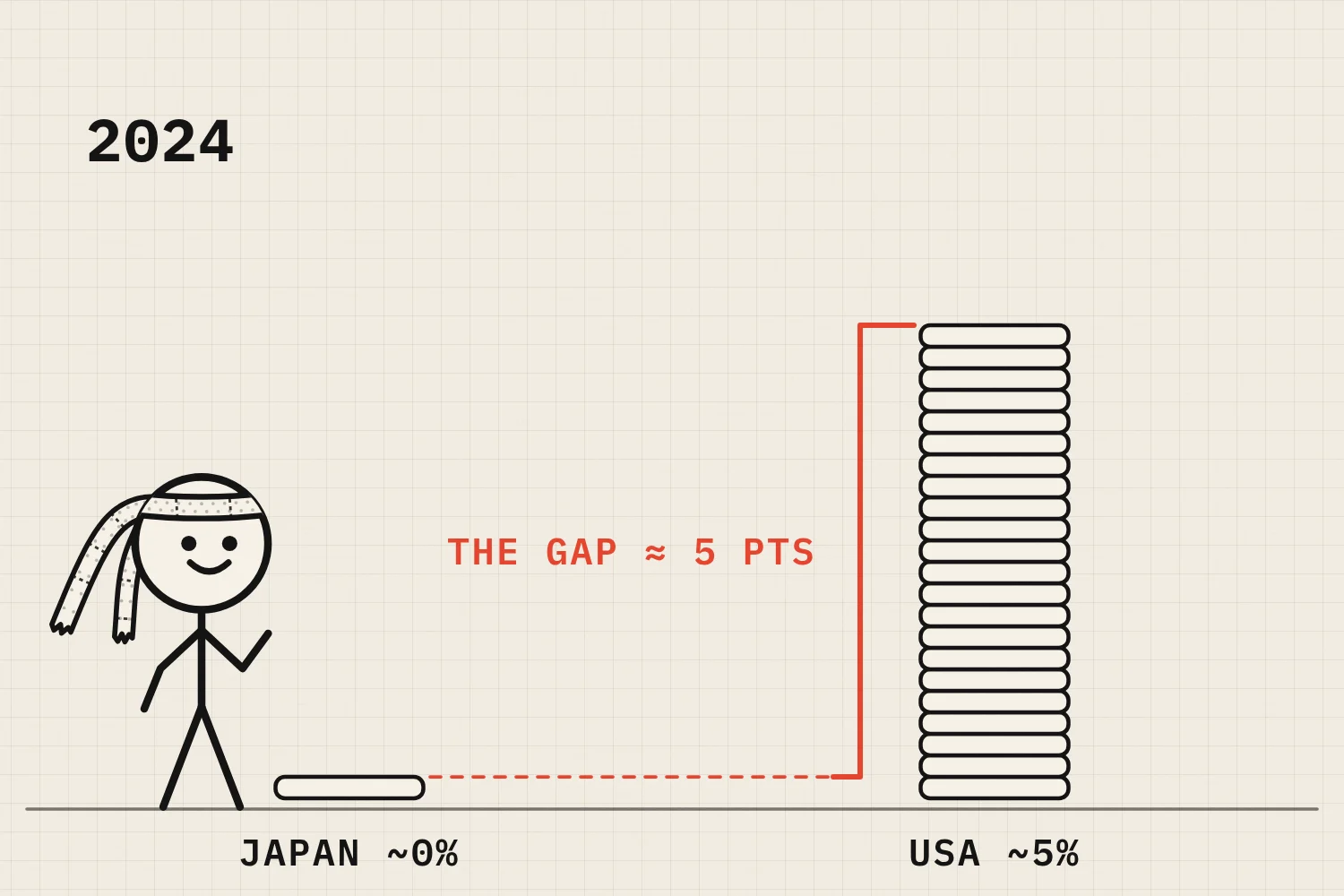
In 2024, Japan's stack is almost empty and the US stack is tall, with a gap of about 5 points.
2024: a big, comfy gap.
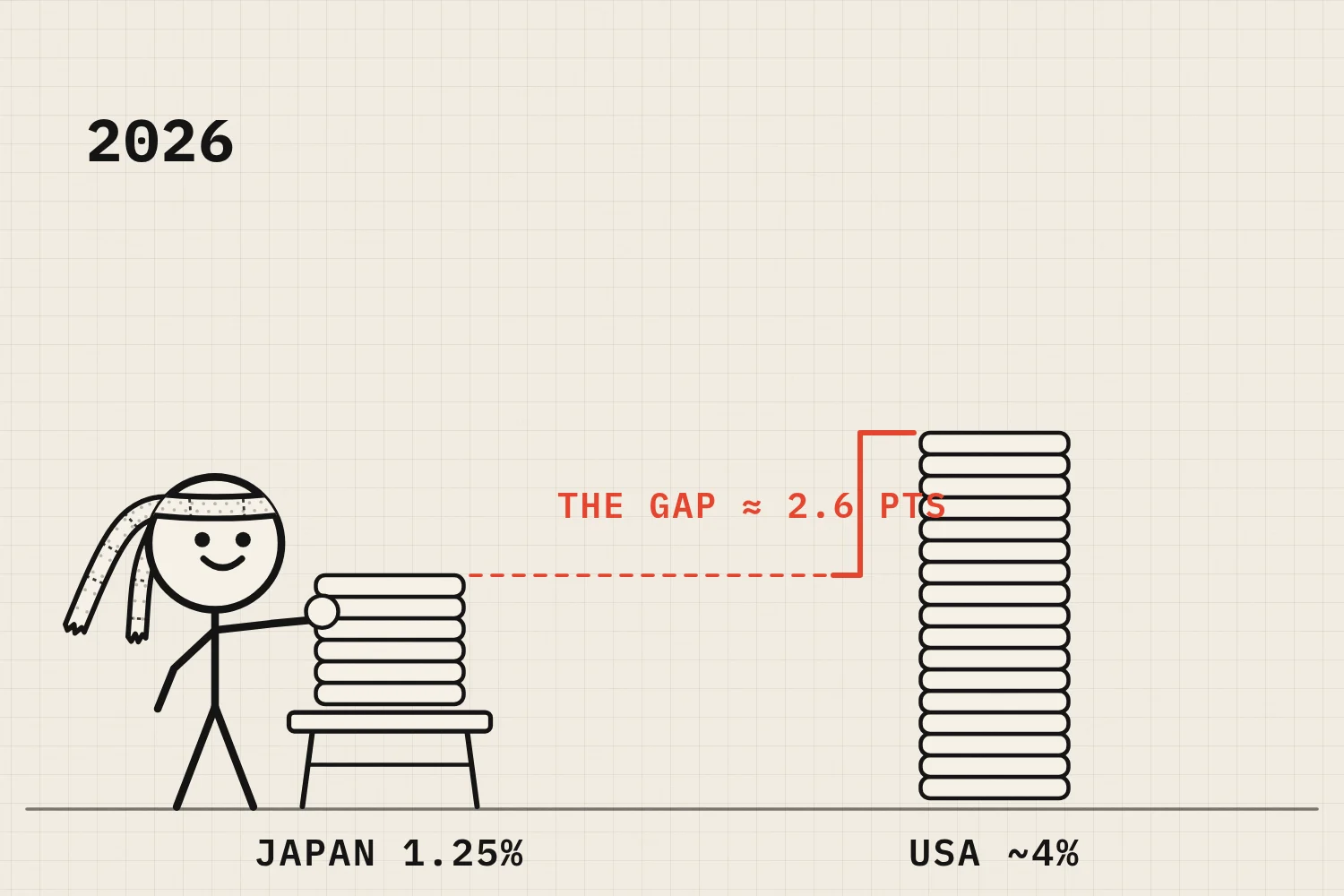
In 2026 TP adds a coin to Japan's 1.25 percent stack, and the gap to the US stack is about 2.6 points.
2026: the gap shrank. It didn't close.
On a yen-per-dollar ruler, TP stands at 157.5 and a dashed breakeven line sits near 153.5.
A 2.6-point cushion only covers a yen move to about 153.5. Past that, the year is a loss.
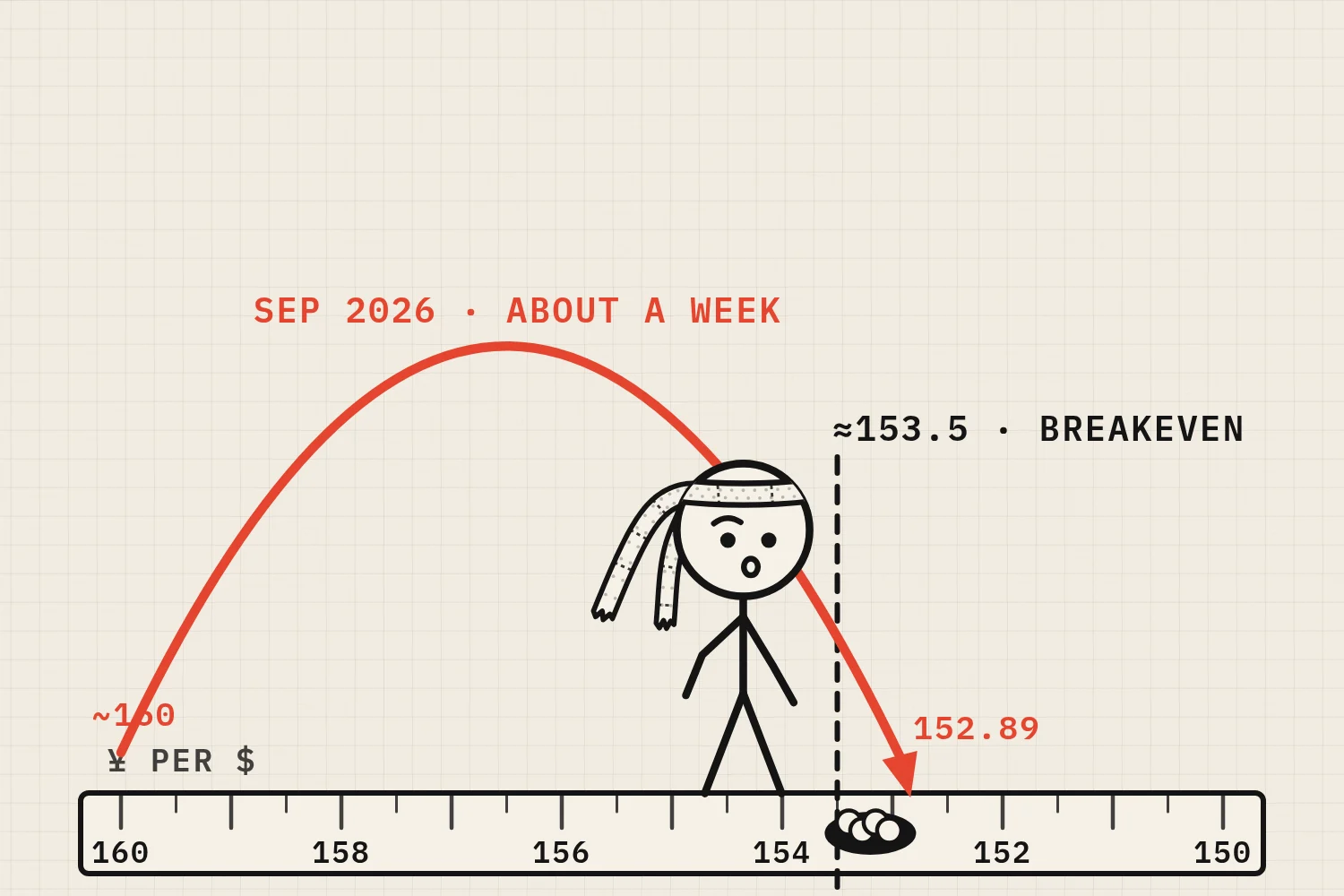
An arrow on the ruler jumps from about 160 to 152.89 in a week, past the breakeven line, and TP's coin pile falls through.
Early September 2026: from about 160 to 152.89 in about a week. More than a year of carry, gone.

And 2026 has been wild for the yen. In July it hit about 164 per dollar, a 40-year low, and Japan and the US jointly bought yen to stop the slide.3673738 In early September the yen ripped from about 160 to 152.89 in roughly a week as traders bet on the September hike and dumped their yen shorts.3940 Remember the breakeven? That move was bigger than a whole year’s carry, in about a week. Reuters’ headline: the yen’s sudden surge “upsets the carry trade faithful.”39

Then the Bank of Japan hiked, two members voted against it, and the yen got weaker, past 157.45 Markets wanted a louder promise of more hikes and didn’t get one. On October 30 the dollar bought about 157.5 yen.2021

One more thing changed, and it’s the one I’d watch. Japan’s 10-year government bond yield hit 3.115 percent in September, the highest since 1996.4142 For decades, if a Japanese pension fund or insurer wanted any real interest, it basically had to go abroad to get it. Now they can earn about 3 percent at home. Some of that money, including some of the $1 trillion-plus in US Treasuries, may come back.43 If it does, it would push up the yen and squeeze anyone still borrowing it.

So that’s the yen carry trade. Borrow the cheap currency, park it in the one that pays, keep the gap, and hope the cheap one stays cheap. Most days the steamroller barely moves. The problem is that everyone standing in front of it finds out at the same time, usually on a Monday.

Go deeper

If you want the real documents.

Sources ()
  1. Bank of Japan, Statement on Monetary Policy, October 30, 2026. Policy rate held at 1.25 percent, 8–1; Takata proposed 1.5 percent. Underlying inflation “generally consistent” with the 2 percent target. BOJ.
  2. CNBC, October 30, 2026. The hold, the dissent, the first “generally consistent” assessment since the target was set in 2013, and a possible December hike. CNBC.
  3. Bank of Japan, Change in the Guideline for Money Market Operations, September 18, 2026. Hike to 1.25 percent, 7–2. BOJ.
  4. Lim Hui Jie, “Why Japan’s markets flipped the usual script after central bank rate hike,” CNBC, September 18, 2026. 1.25 percent, highest since 1995; 7–2 with Asada and Sato dissenting; yen weakened past 157; the BOJ cited high oil prices from the Middle East conflict. CNBC.
  5. Bloomberg, “Yen Plunges After BOJ Fails to Meet Market Demands With Rate Hike,” September 18, 2026. Bloomberg.
  6. Bank of Japan, policy decision, June 16, 2026. Hike to 1 percent. BOJ.
  7. Peter Hoskins, “US and Japan take action to prop up yen in rare joint move,” BBC, August 3, 2026. First joint intervention since 2011; the yen’s 40-year low of 164 in July; the June hike to 1 percent, highest since September 1995. BBC.
  8. Bank of Japan, Change in the Guideline for Money Market Operations, December 19, 2025. Hike to 0.75 percent. BOJ.
  9. Reuters, “Bank of Japan raises rates to 30-year high, signals more hikes,” December 19, 2025. Reuters.
  10. Bank of Japan, Change in the Guideline for Money Market Operations, January 24, 2025. Hike to 0.5 percent. BOJ.
  11. Reuters, “Bank of Japan raises interest rates to highest in 17 years, yen jumps,” January 24, 2025. Reuters.
  12. Reuters, “Japan yields scale 15-year peaks, bank shares surge as BOJ hikes rates,” July 31, 2024. Hike to about 0.25 percent. Reuters.
  13. AP, “Bank of Japan raises its key interest rate, aiming to curb yen’s slide against the dollar,” July 31, 2024. AP.
  14. Bank of Japan, Changes in the Monetary Policy Framework, March 19, 2024. End of the minus 0.1 percent rate. BOJ.
  15. Reuters, “Bank of Japan scraps radical policy, makes first rate hike in 17 years,” March 19, 2024. Reuters.
  16. Federal Reserve, FOMC statement, October 28, 2026. Target range held at 3.75 to 4.00 percent; Cook and Hammack preferred a hike. Federal Reserve.
  17. CNBC, “Fed holds rates steady,” October 28, 2026. CNBC.
  18. Federal Reserve, FOMC statement, July 31, 2024. Target range 5.25 to 5.50 percent. Federal Reserve.
  19. Reuters, “FOMC does not change rates, but sets stage for September cut,” July 31, 2024. Reuters.
  20. Bank of Japan, foreign exchange market daily, October 30, 2026. 17:00 JST dollar-yen 157.55–56. BOJ.
  21. ExchangeRates.org.uk, US dollar to yen history, October 2026. Close of 157.53 on October 30. ExchangeRates.org.uk.
  22. Lim Hui Jie, “Japan’s yen has seen wild swings this year,” CNBC, August 23, 2024. 161.99 on July 3 to 141.66 on August 5, over 12 percent. CNBC.
  23. CNBC, “Yen drops to 38-year low,” July 4, 2024. CNBC.
  24. Reuters, “Japan’s Nikkei sees biggest rout since 1987 Black Monday,” August 5, 2024. Down 12.4 percent to 31,458.42, a 4,451-point drop. Reuters.
  25. AP, “Japan’s Nikkei 225 stock index plunges as investors dump shares,” August 5, 2024. AP.
  26. Reuters, “Japanese shares rebound sharply after biggest rout since 1987 Black Monday,” August 6, 2024. Reuters.
  27. Nikkei Asia, “Japan stocks rebound 3,217 points for their largest single-day rise,” August 6, 2024. Nikkei Asia.
  28. BIS Bulletin 90, “The market turbulence and carry trade unwind of August 2024,” August 27, 2024. Trigger, amplification, ¥40 trillion estimate, ¥80 trillion bank claims, retail “Mrs Watanabe” trading, Swiss franc and peso moves, recovery by August 9. BIS.
  29. Karamfil Todorov and Grigory Vilkov, BIS Bulletin 95, “Anatomy of the VIX spike in August 2024,” October 29, 2024. BIS.
  30. CNBC, “Wall Street’s ‘fear gauge’ the VIX rises to highest since 2020,” August 5, 2024. CNBC.
  31. Reuters, “Wall Street ‘fear gauge’ logs record jump as investors bet on more turbulence,” August 5, 2024. Reuters.
  32. Reuters, “Global market rout has more to do with end of cheap funding than US economy,” August 5, 2024. Reuters.
  33. Shinichi Uchida, speech in Hakodate, Bank of Japan, August 7, 2024. BOJ.
  34. Reuters, “BOJ deputy governor plays down chance of near-term rate hike, yen slumps,” August 7, 2024. Reuters.
  35. Reserve Bank of Australia Bulletin, “Japanese Retail Investors and the Carry Trade,” March 2009. RBA.
  36. Japan Ministry of Finance, statement by Finance Minister Katayama Satsuki, August 3, 2026. Yen purchased on July 31 in coordination with the US Treasury. MOF.
  37. Nikkei Asia, “Yen nears 164 and yields rise as oil prices hit $100 per barrel,” July 2026. Nikkei Asia.
  38. CNBC, “Dollar eases against yen as intervention risks keep traders wary,” July 31, 2026. CNBC.
  39. Ankur Banerjee and Rocky Swift, “The yen’s sudden surge upsets the carry trade faithful,” Reuters, September 8, 2026. Yen at 152.89, strongest since February, from about 160 a week earlier. Reuters via Yahoo Finance.
  40. Mainichi, “Dollar briefly falls into 152 yen zone amid BOJ rate hike speculation,” September 8, 2026, and the Bank of Japan’s daily quotes for September 2 (160.20) and September 8 (low 152.90). Mainichi, BOJ.
  41. Kyodo News, “Japan 10-yr gov’t bond yield climbs to 3.115%, highest since August 1996,” September 25, 2026. Kyodo.
  42. NHK World, “10-year JGB yield at 3-decade high,” September 25, 2026. NHK.
  43. US Treasury, Major Foreign Holders of Treasury Securities. Japan $1,068.3 billion, August 2026, the largest. Treasury.
  44. DL News, “The $250bn ‘carry trade’ woes are far from over, BIS warns,” August 2024. DL News.
  45. US Treasury, Treasury International Capital data for August 2026. Treasury.
  46. Reuters, “Resurgent yen brings high-flying Japan Inc back to earth,” August 5, 2024. A stronger yen squeezes exporters’ overseas earnings; Toyota down 13.7 percent. Reuters.
Newsletter

Get the next rabbit hole before everyone else.

Just a quick email when a new rabbit hole drops. If you were on the old Substack, you're already on it.

Or subscribe on Substack